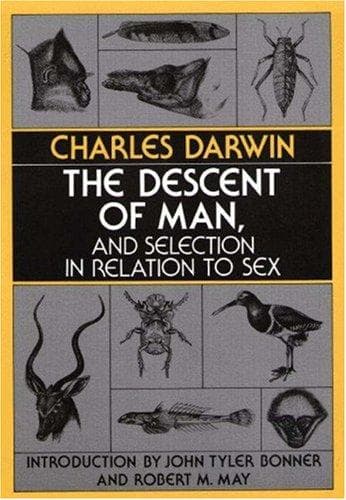
The Descent of Man, and Selection in Relation to SexDarwin, Charles
History
The Descent of Man, and Selection in Relation to Sex
Darwin, Charles
Evolution (Biology); Human beings -- Origin; Sex differences; Sexual dimorphism (Animals); Sexual selection in animals
Thus his brother Fritz Müller
has noticed in Brazil that the two sexes of the same species of bee
sometimes frequent different kinds of flowers. With respect to the
Orthoptera, I know hardly anything about the relative number of the
sexes: Korte (88. ‘Die Strich, Zug oder Wanderheuschrecke,’ 1828, p.
20.), however, says that out of 500 locusts which he examined, the
males were to the females as five to six. With the Neuroptera, Mr.
Walsh states that in many, but by no means in all the species of the
Odonatous group, there is a great overplus of males: in the genus
Hetaerina, also, the males are generally at least four times as
numerous as the females. In certain species in the genus Gomphus the
males are equally in excess, whilst in two other species, the females
are twice or thrice as numerous as the males. In some European species
of Psocus thousands of females may be collected without a single male,
whilst with other species of the same genus both sexes are common. (89.
‘Observations on N. American Neuroptera,’ by H. Hagen and B.D. Walsh,
‘Proceedings, Ent. Soc. Philadelphia,’ Oct. 1863, pp. 168, 223, 239.)
In England, Mr. MacLachlan has captured hundreds of the female Apatania
muliebris, but has never seen the male; and of Boreus hyemalis only
four or five males have been seen here. (90. ‘Proceedings, Ent. Soc.
London,’ Feb. 17, 1868.) With most of these species (excepting the
Tenthredinae) there is at present no evidence that the females are
subject to parthenogenesis; and thus we see how ignorant we are of the
causes of the apparent discrepancy in the proportion of the two sexes.
In the other classes of the Articulata I have been able to collect
still less information. With spiders, Mr. Blackwall, who has carefully
attended to this class during many years, writes to me that the males
from their more erratic habits are more commonly seen, and therefore
appear more numerous. This is actually the case with a few species; but
he mentions several species in six genera, in which the females appear
to be much more numerous than the males. (91. Another great authority
with respect to this class, Prof. Thorell of Upsala (‘On European
Spiders,’ 1869-70, part i. p. 205), speaks as if female spiders were
generally commoner than the males.) The small size of the males in
comparison with the females (a peculiarity which is sometimes carried
to an extreme degree), and their widely different appearance, may
account in some instances for their rarity in collections. (92. See, on
this subject, Mr. O.P. Cambridge, as quoted in ‘Quarterly Journal of
Science,’ 1868, page 429.)
Public-domain text, read in full here on John Shaqi.
Reviews
Reviews
No reviews yet
Be the first to share your thoughts on this work.
Elsewhere in the archive
Join the Discussion
Join the discussion
Sign in to leave a comment or review.
Sign InorCreate an account