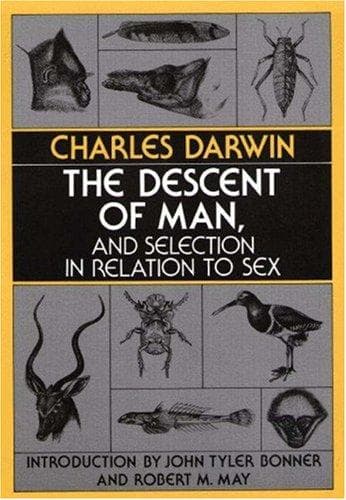
The Descent of Man, and Selection in Relation to SexDarwin, Charles
History
The Descent of Man, and Selection in Relation to Sex
Darwin, Charles
Evolution (Biology); Human beings -- Origin; Sex differences; Sexual dimorphism (Animals); Sexual selection in animals
The belief that there exists in man some close relation between the
size of the brain and the development of the intellectual faculties is
supported by the comparison of the skulls of savage and civilised
races, of ancient and modern people, and by the analogy of the whole
vertebrate series. Dr. J. Barnard Davis has proved (79. ‘Philosophical
Transactions,’ 1869, p. 513.), by many careful measurements, that the
mean internal capacity of the skull in Europeans is 92.3 cubic inches;
in Americans 87.5; in Asiatics 87.1; and in Australians only 81.9 cubic
inches. Professor Broca (80. ‘Les Selections,’ M. P. Broca, ‘Revue
d’Anthropologies,’ 1873; see also, as quoted in C. Vogt’s ‘Lectures on
Man,’ Engl. translat., 1864, pp. 88, 90. Prichard, ‘Physical History of
Mankind,’ vol. i. 1838, p. 305.) found that the nineteenth century
skulls from graves in Paris were larger than those from vaults of the
twelfth century, in the proportion of 1484 to 1426; and that the
increased size, as ascertained by measurements, was exclusively in the
frontal part of the skull—the seat of the intellectual faculties.
Prichard is persuaded that the present inhabitants of Britain have
“much more capacious brain-cases” than the ancient inhabitants.
Nevertheless, it must be admitted that some skulls of very high
antiquity, such as the famous one of Neanderthal, are well developed
and capacious. (81. In the interesting article just referred to, Prof.
Broca has well remarked, that in civilised nations, the average
capacity of the skull must be lowered by the preservation of a
considerable number of individuals, weak in mind and body, who would
have been promptly eliminated in the savage state. On the other hand,
with savages, the average includes only the more capable individuals,
who have been able to survive under extremely hard conditions of life.
Broca thus explains the otherwise inexplicable fact, that the mean
capacity of the skull of the ancient Troglodytes of Lozere is greater
than that of modern Frenchmen.) With respect to the lower animals, M.E.
Lartet (82. ‘Comptes-rendus des Sciences,’ etc., June 1, 1868.), by
comparing the crania of tertiary and recent mammals belonging to the
same groups, has come to the remarkable conclusion that the brain is
generally larger and the convolutions are more complex in the more
recent forms. On the other hand, I have shewn (83. The ‘Variation of
Animals and Plants under Domestication,’ vol. i. pp. 124-129.) that the
brains of domestic rabbits are considerably reduced in bulk, in
comparison with those of the wild rabbit or hare; and this may be
attributed to their having been closely confined during many
generations, so that they have exerted their intellect, instincts,
senses and voluntary movements but little.
Public-domain text, read in full here on John Shaqi.
Reviews
Reviews
No reviews yet
Be the first to share your thoughts on this work.
Elsewhere in the archive
Join the Discussion
Join the discussion
Sign in to leave a comment or review.
Sign InorCreate an account