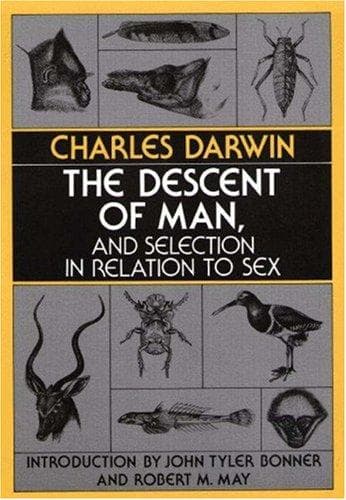
The Descent of Man, and Selection in Relation to SexDarwin, Charles
History
The Descent of Man, and Selection in Relation to Sex
Darwin, Charles
Evolution (Biology); Human beings -- Origin; Sex differences; Sexual dimorphism (Animals); Sexual selection in animals
The gradually increasing weight of the brain and skull in man must have
influenced the development of the supporting spinal column, more
especially whilst he was becoming erect. As this change of position was
being brought about, the internal pressure of the brain will also have
influenced the form of the skull; for many facts shew how easily the
skull is thus affected. Ethnologists believe that it is modified by the
kind of cradle in which infants sleep. Habitual spasms of the muscles,
and a cicatrix from a severe burn, have permanently modified the facial
bones. In young persons whose heads have become fixed either sideways
or backwards, owing to disease, one of the two eyes has changed its
position, and the shape of the skull has been altered apparently by the
pressure of the brain in a new direction. (84. Schaaffhausen gives from
Blumenbach and Busch, the cases of the spasms and cicatrix, in
‘Anthropological Review,’ Oct. 1868, p. 420. Dr. Jarrold
(‘Anthropologia,’ 1808, pp. 115, 116) adduces from Camper and from his
own observations, cases of the modification of the skull from the head
being fixed in an unnatural position. He believes that in certain
trades, such as that of a shoemaker, where the head is habitually held
forward, the forehead becomes more rounded and prominent.) I have shewn
that with long-eared rabbits even so trifling a cause as the lopping
forward of one ear drags forward almost every bone of the skull on that
side; so that the bones on the opposite side no longer strictly
correspond. Lastly, if any animal were to increase or diminish much in
general size, without any change in its mental powers, or if the mental
powers were to be much increased or diminished, without any great
change in the size of the body, the shape of the skull would almost
certainly be altered. I infer this from my observations on domestic
rabbits, some kinds of which have become very much larger than the wild
animal, whilst others have retained nearly the same size, but in both
cases the brain has been much reduced relatively to the size of the
body. Now I was at first much surprised on finding that in all these
rabbits the skull had become elongated or dolichocephalic; for
instance, of two skulls of nearly equal breadth, the one from a wild
rabbit and the other from a large domestic kind, the former was 3.15
and the latter 4.3 inches in length. (85. ‘Variation of Animals and
Plants under Domestication,’ vol. i. p. 117, on the elongation of the
skull; p. 119, on the effect of the lopping of one ear.) One of the
most marked distinctions in different races of men is that the skull in
some is elongated, and in others rounded; and here the explanation
suggested by the case of the rabbits may hold good; for Welcker finds
that short “men incline more to brachycephaly, and tall men to
dolichocephaly” (86. Quoted by Schaaffhausen, in ‘Anthropological
Review,’ Oct. 1868, p. 419.); and tall men may be compared with the
Public-domain text, read in full here on John Shaqi.
Reviews
Reviews
No reviews yet
Be the first to share your thoughts on this work.
Elsewhere in the archive
Join the Discussion
Join the discussion
Sign in to leave a comment or review.
Sign InorCreate an account