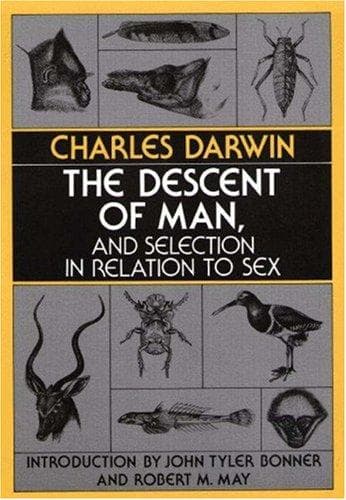
The Descent of Man, and Selection in Relation to SexDarwin, Charles
History
The Descent of Man, and Selection in Relation to Sex
Darwin, Charles
Evolution (Biology); Human beings -- Origin; Sex differences; Sexual dimorphism (Animals); Sexual selection in animals
with the Australians, when the vermin get troublesome, to singe
themselves.”) that within the tropics it is an advantage to man to be
destitute of hair, as he is thus enabled to free himself of the
multitude of ticks (acari) and other parasites, with which he is often
infested, and which sometimes cause ulceration. But whether this evil
is of sufficient magnitude to have led to the denudation of his body
through natural selection, may be doubted, since none of the many
quadrupeds inhabiting the tropics have, as far as I know, acquired any
specialised means of relief. The view which seems to me the most
probable is that man, or rather primarily woman, became divested of
hair for ornamental purposes, as we shall see under Sexual Selection;
and, according to this belief, it is not surprising that man should
differ so greatly in hairiness from all other Primates, for characters,
gained through sexual selection, often differ to an extraordinary
degree in closely related forms.
According to a popular impression, the absence of a tail is eminently
distinctive of man; but as those apes which come nearest to him are
destitute of this organ, its disappearance does not relate exclusively
to man. The tail often differs remarkably in length within the same
genus: thus in some species of Macacus it is longer than the whole
body, and is formed of twenty-four vertebrae; in others it consists of
a scarcely visible stump, containing only three or four vertebrae. In
some kinds of baboons there are twenty-five, whilst in the mandrill
there are ten very small stunted caudal vertebrae, or, according to
Cuvier (90. Mr. St. George Mivart, ‘Proc. Zoolog. Soc.’ 1865, pp. 562,
583. Dr. J.E. Gray, ‘Cat. Brit. Mus.: ‘Skeletons.’ Owen, ‘Anatomy of
Vertebrates,’ vol. ii. p. 517. Isidore Geoffroy, ‘Hist. Nat. Gen.’ tom.
ii. p. 244.), sometimes only five. The tail, whether it be long or
short, almost always tapers towards the end; and this, I presume,
results from the atrophy of the terminal muscles, together with their
arteries and nerves, through disuse, leading to the atrophy of the
terminal bones. But no explanation can at present be given of the great
diversity which often occurs in its length. Here, however, we are more
specially concerned with the complete external disappearance of the
tail. Professor Broca has recently shewn (91. ‘Revue d’Anthropologie,’
1872; ‘La Constitution des vertèbres caudales.’) that the tail in all
quadrupeds consists of two portions, generally separated abruptly from
each other; the basal portion consists of vertebrae, more or less
perfectly channelled and furnished with apophyses like ordinary
vertebrae; whereas those of the terminal portion are not channelled,
are almost smooth, and scarcely resemble true vertebrae. A tail, though
not externally visible, is really present in man and the
anthropomorphous apes, and is constructed on exactly the same pattern
in both. In the terminal portion the vertebrae, constituting the os
Public-domain text, read in full here on John Shaqi.
Reviews
Reviews
No reviews yet
Be the first to share your thoughts on this work.
Elsewhere in the archive
Join the Discussion
Join the discussion
Sign in to leave a comment or review.
Sign InorCreate an account