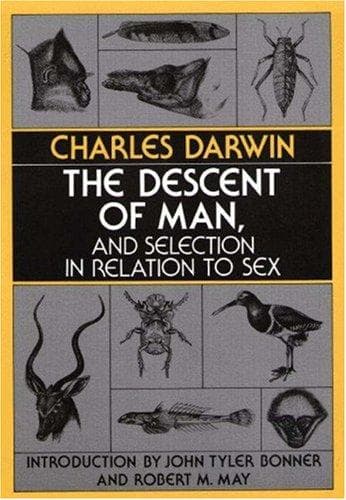
The Descent of Man, and Selection in Relation to SexDarwin, Charles
History
The Descent of Man, and Selection in Relation to Sex
Darwin, Charles
Evolution (Biology); Human beings -- Origin; Sex differences; Sexual dimorphism (Animals); Sexual selection in animals
coccyx, are quite rudimentary, being much reduced in size and number.
In the basal portion, the vertebrae are likewise few, are united firmly
together, and are arrested in development; but they have been rendered
much broader and flatter than the corresponding vertebrae in the tails
of other animals: they constitute what Broca calls the accessory sacral
vertebrae. These are of functional importance by supporting certain
internal parts and in other ways; and their modification is directly
connected with the erect or semi-erect attitude of man and the
anthropomorphous apes. This conclusion is the more trustworthy, as
Broca formerly held a different view, which he has now abandoned. The
modification, therefore, of the basal caudal vertebrae in man and the
higher apes may have been effected, directly or indirectly, through
natural selection.
But what are we to say about the rudimentary and variable vertebrae of
the terminal portion of the tail, forming the os coccyx? A notion which
has often been, and will no doubt again be ridiculed, namely, that
friction has had something to do with the disappearance of the external
portion of the tail, is not so ridiculous as it at first appears. Dr.
Anderson (92. ‘Proceedings Zoological Society,’ 1872, p. 210.) states
that the extremely short tail of Macacus brunneus is formed of eleven
vertebrae, including the imbedded basal ones. The extremity is
tendinous and contains no vertebrae; this is succeeded by five
rudimentary ones, so minute that together they are only one line and a
half in length, and these are permanently bent to one side in the shape
of a hook. The free part of the tail, only a little above an inch in
length, includes only four more small vertebrae. This short tail is
carried erect; but about a quarter of its total length is doubled on to
itself to the left; and this terminal part, which includes the
hook-like portion, serves “to fill up the interspace between the upper
divergent portion of the callosities;” so that the animal sits on it,
and thus renders it rough and callous. Dr. Anderson thus sums up his
observations: “These facts seem to me to have only one explanation;
this tail, from its short size, is in the monkey’s way when it sits
down, and frequently becomes placed under the animal while it is in
this attitude; and from the circumstance that it does not extend beyond
the extremity of the ischial tuberosities, it seems as if the tail
originally had been bent round by the will of the animal, into the
interspace between the callosities, to escape being pressed between
them and the ground, and that in time the curvature became permanent,
fitting in of itself when the organ happens to be sat upon.” Under
these circumstances it is not surprising that the surface of the tail
should have been roughened and rendered callous, and Dr. Murie (93.
‘Proceedings Zoological Society,’ 1872, p. 786.), who carefully
observed this species in the Zoological Gardens, as well as three other
Public-domain text, read in full here on John Shaqi.
Reviews
Reviews
No reviews yet
Be the first to share your thoughts on this work.
Elsewhere in the archive
Join the Discussion
Join the discussion
Sign in to leave a comment or review.
Sign InorCreate an account