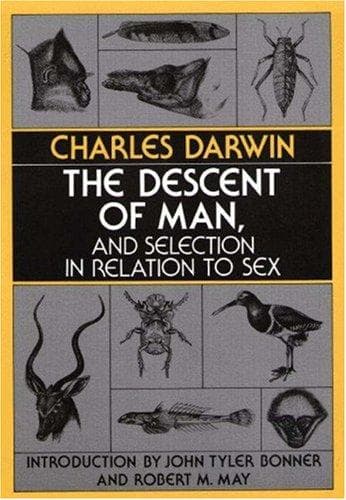
The Descent of Man, and Selection in Relation to SexDarwin, Charles
History
The Descent of Man, and Selection in Relation to Sex
Darwin, Charles
Evolution (Biology); Human beings -- Origin; Sex differences; Sexual dimorphism (Animals); Sexual selection in animals
I have now endeavoured to shew that some of the most distinctive
characters of man have in all probability been acquired, either
directly, or more commonly indirectly, through natural selection. We
should bear in mind that modifications in structure or constitution
which do not serve to adapt an organism to its habits of life, to the
food which it consumes, or passively to the surrounding conditions,
cannot have been thus acquired. We must not, however, be too confident
in deciding what modifications are of service to each being: we should
remember how little we know about the use of many parts, or what
changes in the blood or tissues may serve to fit an organism for a new
climate or new kinds of food. Nor must we forget the principle of
correlation, by which, as Isidore Geoffroy has shewn in the case of
man, many strange deviations of structure are tied together.
Independently of correlation, a change in one part often leads, through
the increased or decreased use of other parts, to other changes of a
quite unexpected nature. It is also well to reflect on such facts, as
the wonderful growth of galls on plants caused by the poison of an
insect, and on the remarkable changes of colour in the plumage of
parrots when fed on certain fishes, or inoculated with the poison of
toads (95. The ‘Variation of Animals and Plants under Domestication,’
vol. ii. pp. 280, 282.); for we can thus see that the fluids of the
system, if altered for some special purpose, might induce other
changes. We should especially bear in mind that modifications acquired
and continually used during past ages for some useful purpose, would
probably become firmly fixed, and might be long inherited.
Public-domain text, read in full here on John Shaqi.
Reviews
Reviews
No reviews yet
Be the first to share your thoughts on this work.
Elsewhere in the archive
Join the Discussion
Join the discussion
Sign in to leave a comment or review.
Sign InorCreate an account