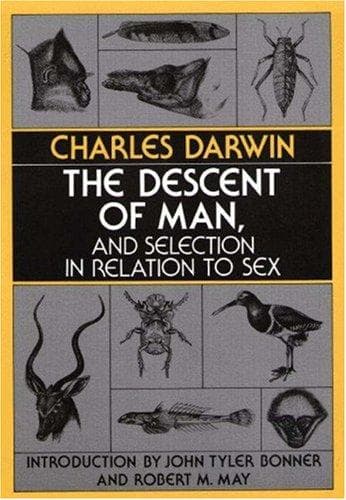
The Descent of Man, and Selection in Relation to SexDarwin, Charles
History
The Descent of Man, and Selection in Relation to Sex
Darwin, Charles
Evolution (Biology); Human beings -- Origin; Sex differences; Sexual dimorphism (Animals); Sexual selection in animals
closely allied forms with slightly longer tails, says that when the
animal sits down, the tail “is necessarily thrust to one side of the
buttocks; and whether long or short its root is consequently liable to
be rubbed or chafed.” As we now have evidence that mutilations
occasionally produce an inherited effect (94. I allude to Dr.
Brown-Sequard’s observations on the transmitted effect of an operation
causing epilepsy in guinea-pigs, and likewise more recently on the
analogous effects of cutting the sympathetic nerve in the neck. I shall
hereafter have occasion to refer to Mr. Salvin’s interesting case of
the apparently inherited effects of mot-mots biting off the barbs of
their own tail-feathers. See also on the general subject ‘Variation of
Animals and Plants under Domestication,’ vol. ii. pp. 22-24.), it is
not very improbable that in short-tailed monkeys, the projecting part
of the tail, being functionally useless, should after many generations
have become rudimentary and distorted, from being continually rubbed
and chafed. We see the projecting part in this condition in the Macacus
brunneus, and absolutely aborted in the M. ecaudatus and in several of
the higher apes. Finally, then, as far as we can judge, the tail has
disappeared in man and the anthropomorphous apes, owing to the terminal
portion having been injured by friction during a long lapse of time;
the basal and embedded portion having been reduced and modified, so as
to become suitable to the erect or semi-erect position.
Public-domain text, read in full here on John Shaqi.
Reviews
Reviews
No reviews yet
Be the first to share your thoughts on this work.
Elsewhere in the archive
Join the Discussion
Join the discussion
Sign in to leave a comment or review.
Sign InorCreate an account