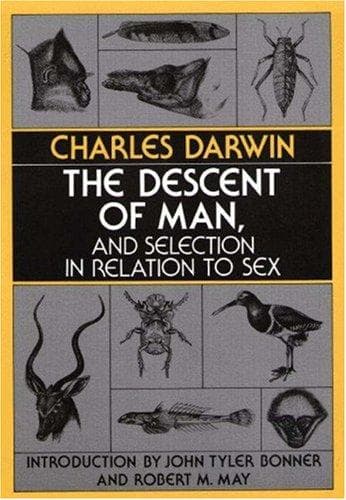
The Descent of Man, and Selection in Relation to SexDarwin, Charles
History
The Descent of Man, and Selection in Relation to Sex
Darwin, Charles
Evolution (Biology); Human beings -- Origin; Sex differences; Sexual dimorphism (Animals); Sexual selection in animals
We have seen in the last two chapters that man bears in his bodily
structure clear traces of his descent from some lower form; but it may
be urged that, as man differs so greatly in his mental power from all
other animals, there must be some error in this conclusion. No doubt
the difference in this respect is enormous, even if we compare the mind
of one of the lowest savages, who has no words to express any number
higher than four, and who uses hardly any abstract terms for common
objects or for the affections (1. See the evidence on those points, as
given by Lubbock, ‘Prehistoric Times,’ p. 354, etc.), with that of the
most highly organised ape. The difference would, no doubt, still remain
immense, even if one of the higher apes had been improved or civilised
as much as a dog has been in comparison with its parent-form, the wolf
or jackal. The Fuegians rank amongst the lowest barbarians; but I was
continually struck with surprise how closely the three natives on board
H.M.S. “Beagle,” who had lived some years in England, and could talk a
little English, resembled us in disposition and in most of our mental
faculties. If no organic being excepting man had possessed any mental
power, or if his powers had been of a wholly different nature from
those of the lower animals, then we should never have been able to
convince ourselves that our high faculties had been gradually
developed. But it can be shewn that there is no fundamental difference
of this kind. We must also admit that there is a much wider interval in
mental power between one of the lowest fishes, as a lamprey or
lancelet, and one of the higher apes, than between an ape and man; yet
this interval is filled up by numberless gradations.
Nor is the difference slight in moral disposition between a barbarian,
such as the man described by the old navigator Byron, who dashed his
child on the rocks for dropping a basket of sea-urchins, and a Howard
or Clarkson; and in intellect, between a savage who uses hardly any
abstract terms, and a Newton or Shakspeare. Differences of this kind
between the highest men of the highest races and the lowest savages,
are connected by the finest gradations. Therefore it is possible that
they might pass and be developed into each other.
My object in this chapter is to shew that there is no fundamental
difference between man and the higher mammals in their mental
faculties. Each division of the subject might have been extended into a
separate essay, but must here be treated briefly. As no classification
of the mental powers has been universally accepted, I shall arrange my
remarks in the order most convenient for my purpose; and will select
those facts which have struck me most, with the hope that they may
produce some effect on the reader.
Public-domain text, read in full here on John Shaqi.
Reviews
Reviews
No reviews yet
Be the first to share your thoughts on this work.
Elsewhere in the archive
Join the Discussion
Join the discussion
Sign in to leave a comment or review.
Sign InorCreate an account