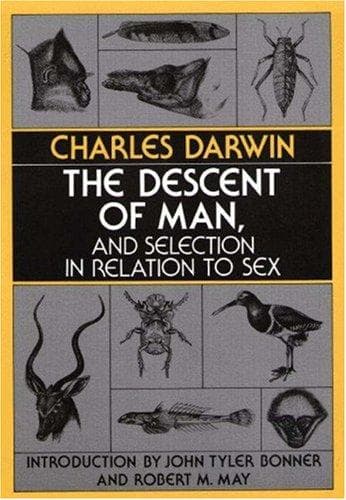
The Descent of Man, and Selection in Relation to SexDarwin, Charles
History
The Descent of Man, and Selection in Relation to Sex
Darwin, Charles
Evolution (Biology); Human beings -- Origin; Sex differences; Sexual dimorphism (Animals); Sexual selection in animals
We will now turn to the more intellectual emotions and faculties, which
are very important, as forming the basis for the development of the
higher mental powers. Animals manifestly enjoy excitement, and suffer
from ennui, as may be seen with dogs, and, according to Rengger, with
monkeys. All animals feel WONDER, and many exhibit CURIOSITY. They
sometimes suffer from this latter quality, as when the hunter plays
antics and thus attracts them; I have witnessed this with deer, and so
it is with the wary chamois, and with some kinds of wild-ducks. Brehm
gives a curious account of the instinctive dread, which his monkeys
exhibited, for snakes; but their curiosity was so great that they could
not desist from occasionally satiating their horror in a most human
fashion, by lifting up the lid of the box in which the snakes were
kept. I was so much surprised at his account, that I took a stuffed and
coiled-up snake into the monkey-house at the Zoological Gardens, and
the excitement thus caused was one of the most curious spectacles which
I ever beheld. Three species of Cercopithecus were the most alarmed;
they dashed about their cages, and uttered sharp signal cries of
danger, which were understood by the other monkeys. A few young monkeys
and one old Anubis baboon alone took no notice of the snake. I then
placed the stuffed specimen on the ground in one of the larger
compartments. After a time all the monkeys collected round it in a
large circle, and staring intently, presented a most ludicrous
appearance. They became extremely nervous; so that when a wooden ball,
with which they were familiar as a plaything, was accidentally moved in
the straw, under which it was partly hidden, they all instantly started
away. These monkeys behaved very differently when a dead fish, a mouse
(12. I have given a short account of their behaviour on this occasion
in my ‘Expression of the Emotions in Man and Animals,’ p. 43.), a
living turtle, and other new objects were placed in their cages; for
though at first frightened, they soon approached, handled and examined
them. I then placed a live snake in a paper bag, with the mouth loosely
closed, in one of the larger compartments. One of the monkeys
immediately approached, cautiously opened the bag a little, peeped in,
and instantly dashed away. Then I witnessed what Brehm has described,
for monkey after monkey, with head raised high and turned on one side,
could not resist taking a momentary peep into the upright bag, at the
dreadful object lying quietly at the bottom. It would almost appear as
if monkeys had some notion of zoological affinities, for those kept by
Brehm exhibited a strange, though mistaken, instinctive dread of
innocent lizards and frogs. An orang, also, has been known to be much
alarmed at the first sight of a turtle. (13. W.C.L. Martin, ‘Natural
History of Mammalia,’ 1841, p. 405.)
Public-domain text, read in full here on John Shaqi.
Reviews
Reviews
No reviews yet
Be the first to share your thoughts on this work.
Elsewhere in the archive
Join the Discussion
Join the discussion
Sign in to leave a comment or review.
Sign InorCreate an account