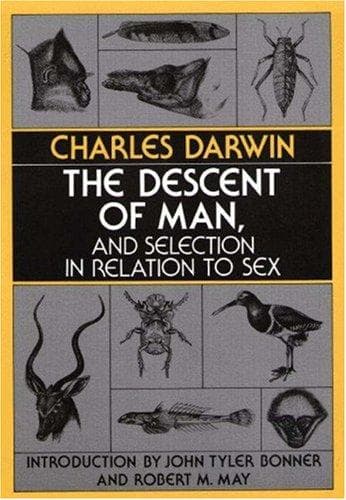
The Descent of Man, and Selection in Relation to SexDarwin, Charles
History
The Descent of Man, and Selection in Relation to Sex
Darwin, Charles
Evolution (Biology); Human beings -- Origin; Sex differences; Sexual dimorphism (Animals); Sexual selection in animals
Hardly any faculty is more important for the intellectual progress of
man than ATTENTION. Animals clearly manifest this power, as when a cat
watches by a hole and prepares to spring on its prey. Wild animals
sometimes become so absorbed when thus engaged, that they may be easily
approached. Mr. Bartlett has given me a curious proof how variable this
faculty is in monkeys. A man who trains monkeys to act in plays, used
to purchase common kinds from the Zoological Society at the price of
five pounds for each; but he offered to give double the price, if he
might keep three or four of them for a few days, in order to select
one. When asked how he could possibly learn so soon, whether a
particular monkey would turn out a good actor, he answered that it all
depended on their power of attention. If when he was talking and
explaining anything to a monkey, its attention was easily distracted,
as by a fly on the wall or other trifling object, the case was
hopeless. If he tried by punishment to make an inattentive monkey act,
it turned sulky. On the other hand, a monkey which carefully attended
to him could always be trained.
It is almost superfluous to state that animals have excellent MEMORIES
for persons and places. A baboon at the Cape of Good Hope, as I have
been informed by Sir Andrew Smith, recognised him with joy after an
absence of nine months. I had a dog who was savage and averse to all
strangers, and I purposely tried his memory after an absence of five
years and two days. I went near the stable where he lived, and shouted
to him in my old manner; he shewed no joy, but instantly followed me
out walking, and obeyed me, exactly as if I had parted with him only
half an hour before. A train of old associations, dormant during five
years, had thus been instantaneously awakened in his mind. Even ants,
as P. Huber (18. ‘Les Moeurs des Fourmis,’ 1810, p. 150.) has clearly
shewn, recognised their fellow-ants belonging to the same community
after a separation of four months. Animals can certainly by some means
judge of the intervals of time between recurrent events.
Public-domain text, read in full here on John Shaqi.
Reviews
Reviews
No reviews yet
Be the first to share your thoughts on this work.
Elsewhere in the archive
Join the Discussion
Join the discussion
Sign in to leave a comment or review.
Sign InorCreate an account