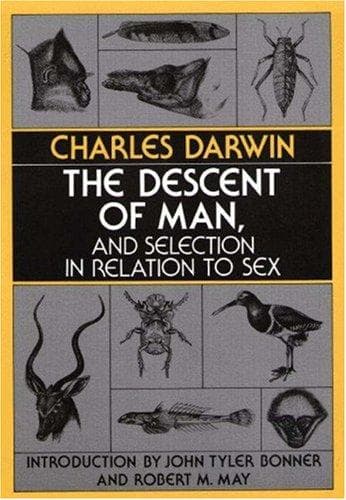
The Descent of Man, and Selection in Relation to SexDarwin, Charles
History
The Descent of Man, and Selection in Relation to Sex
Darwin, Charles
Evolution (Biology); Human beings -- Origin; Sex differences; Sexual dimorphism (Animals); Sexual selection in animals
Of all the faculties of the human mind, it will, I presume, be admitted
that REASON stands at the summit. Only a few persons now dispute that
animals possess some power of reasoning. Animals may constantly be seen
to pause, deliberate, and resolve. It is a significant fact, that the
more the habits of any particular animal are studied by a naturalist,
the more he attributes to reason and the less to unlearnt instincts.
(22. Mr. L.H. Morgan’s work on ‘The American Beaver,’ 1868, offers a
good illustration of this remark. I cannot help thinking, however, that
he goes too far in underrating the power of instinct.) In future
chapters we shall see that some animals extremely low in the scale
apparently display a certain amount of reason. No doubt it is often
difficult to distinguish between the power of reason and that of
instinct. For instance, Dr. Hayes, in his work on ‘The Open Polar Sea,’
repeatedly remarks that his dogs, instead of continuing to draw the
sledges in a compact body, diverged and separated when they came to
thin ice, so that their weight might be more evenly distributed. This
was often the first warning which the travellers received that the ice
was becoming thin and dangerous. Now, did the dogs act thus from the
experience of each individual, or from the example of the older and
wiser dogs, or from an inherited habit, that is from instinct? This
instinct, may possibly have arisen since the time, long ago, when dogs
were first employed by the natives in drawing their sledges; or the
Arctic wolves, the parent-stock of the Esquimaux dog, may have acquired
an instinct impelling them not to attack their prey in a close pack,
when on thin ice.
Public-domain text, read in full here on John Shaqi.
Reviews
Reviews
No reviews yet
Be the first to share your thoughts on this work.
Elsewhere in the archive
Join the Discussion
Join the discussion
Sign in to leave a comment or review.
Sign InorCreate an account