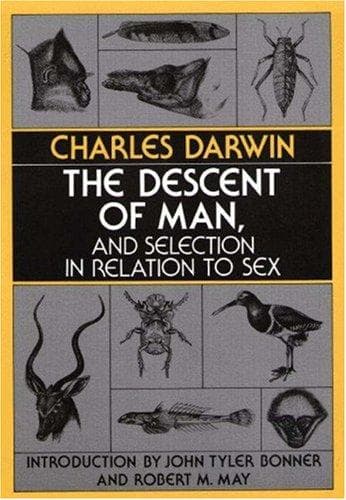
The Descent of Man, and Selection in Relation to SexDarwin, Charles
History
The Descent of Man, and Selection in Relation to Sex
Darwin, Charles
Evolution (Biology); Human beings -- Origin; Sex differences; Sexual dimorphism (Animals); Sexual selection in animals
It may be freely admitted that no animal is self-conscious, if by this
term it is implied, that he reflects on such points, as whence he comes
or whither he will go, or what is life and death, and so forth. But how
can we feel sure that an old dog with an excellent memory and some
power of imagination, as shewn by his dreams, never reflects on his
past pleasures or pains in the chase? And this would be a form of
self-consciousness. On the other hand, as Buchner (45. ‘Conférences sur
la Théorie Darwinienne,’ French translat. 1869, p. 132.) has remarked,
how little can the hard-worked wife of a degraded Australian savage,
who uses very few abstract words, and cannot count above four, exert
her self-consciousness, or reflect on the nature of her own existence.
It is generally admitted, that the higher animals possess memory,
attention, association, and even some imagination and reason. If these
powers, which differ much in different animals, are capable of
improvement, there seems no great improbability in more complex
faculties, such as the higher forms of abstraction, and
self-consciousness, etc., having been evolved through the development
and combination of the simpler ones. It has been urged against the
views here maintained that it is impossible to say at what point in the
ascending scale animals become capable of abstraction, etc.; but who
can say at what age this occurs in our young children? We see at least
that such powers are developed in children by imperceptible degrees.
That animals retain their mental individuality is unquestionable. When
my voice awakened a train of old associations in the mind of the
before-mentioned dog, he must have retained his mental individuality,
although every atom of his brain had probably undergone change more
than once during the interval of five years. This dog might have
brought forward the argument lately advanced to crush all
evolutionists, and said, “I abide amid all mental moods and all
material changes...The teaching that atoms leave their impressions as
legacies to other atoms falling into the places they have vacated is
contradictory of the utterance of consciousness, and is therefore
false; but it is the teaching necessitated by evolutionism,
consequently the hypothesis is a false one.” (46. The Rev. Dr. J.
M’Cann, ‘Anti-Darwinism,’ 1869, p. 13.)
LANGUAGE.
Public-domain text, read in full here on John Shaqi.
Reviews
Reviews
No reviews yet
Be the first to share your thoughts on this work.
Elsewhere in the archive
Join the Discussion
Join the discussion
Sign in to leave a comment or review.
Sign InorCreate an account