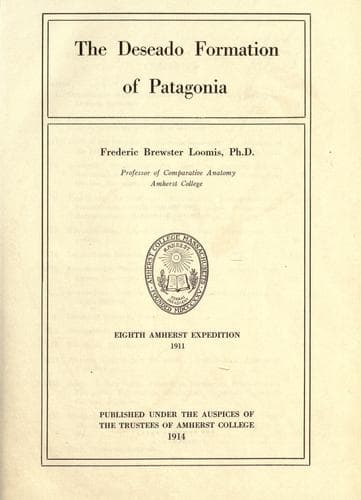
The Deseado Formation of PatagoniaLoomis, Frederic Brewster
Science
The Deseado Formation of Patagonia
Loomis, Frederic Brewster
Paleontology -- Patagonia (Argentina and Chile)
The top of the brain case was crushed in before the burial of the
animal, the anterior part being present, and about 40 mm. below its
normal position, but the parietal region having been loose, exposed
the brain cavity, the ear chamber and some of the cellular vacuities.
The nasal bones are long and light in build, and are pushed back so
that they lie between the postorbital processes of the frontals. The
frontals were united medianly, and prolonged on either side of the
nasals to make the postorbital processes. The back margin of the
frontals is broken away. The parietals are lost, but it is apparent
that there was a short sagittal crest. From the middle, high lambdoidal
crests extend to either side, and become continuous with the upper
margins of the zygomatic arches. The posterior face of the skull slopes
back from the lambdoidal crests for a considerable distance, down to
the moderate sized foramen magnum.
The squamosum is a large bone, with the lambdoidal crest and the
extension of the zygomatic arch on its upper surface. It carries the
major part of the glenoid fossa. Behind the auditory meatus is a
large post-tympanic portion which extends down and unites with the
pre-tympanic portion, completely inclosing the opening of the ear and
crowding the tympanic from being exposed on the side of the skull.
There is a very short paroccipital process, and this posterior portion
of the squamosum is the part which resembles that of elephants,
hyracoids and, to some extent, _Toxodontia_. There is, however, no
cavity in the squamosum as in toxodonts generally. The tympanic bulla
is small, but little swollen, and hollow. It is quite exactly like that
of probocideans. The basioccipital is fused to the exoccipitals. The
occipital condyles are very high above the plane of the teeth, are set
wide apart, and are cylindrical bosses which would not allow a free
movement of the head laterally, but only in the up and down direction.
This last is again a feature of the elephants. The pterygoid bone is
greatly enlarged to compensate for the bend in the basicranial axis,
and the pterygoids, together with the alisphenoids, make broad plates
bounding either side of the posterior nasal chamber, exactly as in
_Palaeomastodon_. The palatal bones are slender in front, and broaden
toward the rear, again, as in elephants.
Public-domain text, read in full here on John Shaqi.
Reviews
Reviews
No reviews yet
Be the first to share your thoughts on this work.
Elsewhere in the archive
Join the Discussion
Join the discussion
Sign in to leave a comment or review.
Sign InorCreate an account