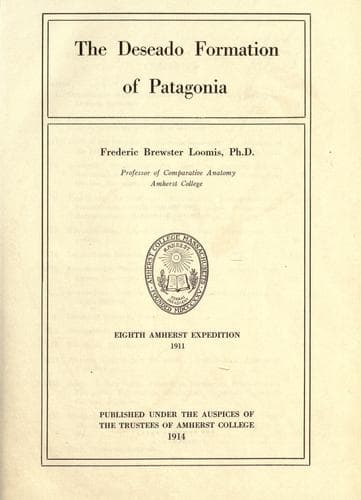
The Deseado Formation of PatagoniaLoomis, Frederic Brewster
Science
The Deseado Formation of Patagonia
Loomis, Frederic Brewster
Paleontology -- Patagonia (Argentina and Chile)
of _Palaeomastodon_. The fusion of the post-tympanic portion of the
squamosum is, in _Palaeomastodon_, much further advanced than in
_Pyrotherium_, so that the passage to the ear is not apparent in the
basal view of the former, but makes a considerable notch on the under
side of the skull of _Pyrotherium_.
The mandibles are excessively thick and heavy, being united at the
symphysis, which extends back to the front of the second molar. The
ascending rami are prolonged backward, but do not rise above the level
of the articulation.
The atlas is a massive vertebra with the anterior cotyles deeply
excavated, especially on the upper side, so that, as Gaudry suggested,
the head must have been carried low. The flat posterior cotyles face
obliquely downward. The neural arch is light and without a spine or
an opening for the vertebral artery. The basal portion of the bone,
however, is excessively heavy and thick; the socket for the odontoid
process not reaching to the middle of the basal bar. The neural canal
is oval in section, being a good deal wider than high, and of small
size. The transverse processes are short, heavy projections, adapted
to receive heavy muscles. On the ventral surface there projects
from the posterior margin a strong hypophysis, which, as Gaudry has
pointed out, is unusual, but which is a character of the atlas of the
_Palaeomastodon_.
The axis is a short, heavy bone, with the anterior cotyles facing
obliquely upward, a small neural arch, no spine, and with a thick
odontoid process, which has the form of a quarter of a hemisphere set
onto the front of the centrum.
Cervicals 3 and 4 are very short vertebrae with light neural arches
and no spines. The neural canal is fully three times as high as
wide. Thus it is entirely evident that the neck of _Pyrotherium_ was
extremely short, as is the case with elephants, which alone would
not be significant, but coincides with many other elephant features.
Gaudry described a lumbar vertebra which is also a short, heavy bone.
Otherwise the vertebral column of _Pyrotherium_ is unknown.
The distal end of the scapula is described by Gaudry as indicating a
short, heavy bone, with the glenoid cavity compressed so as to be about
twice as long as it is wide. The coracoid is a short, blunt process.
The spine was broken off, but enough remained to indicate a moderately
high spine, prolonged toward the humerus, and bent somewhat forward.
Public-domain text, read in full here on John Shaqi.
Reviews
Reviews
No reviews yet
Be the first to share your thoughts on this work.
Elsewhere in the archive
Join the Discussion
Join the discussion
Sign in to leave a comment or review.
Sign InorCreate an account