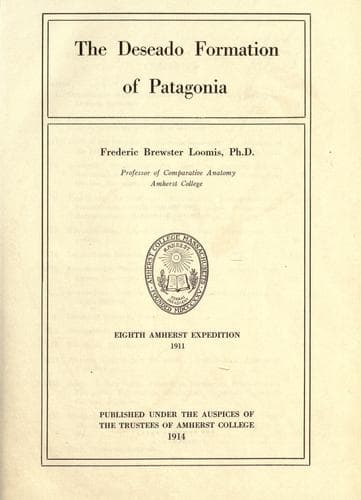
The Deseado Formation of PatagoniaLoomis, Frederic Brewster
Science
The Deseado Formation of Patagonia
Loomis, Frederic Brewster
Paleontology -- Patagonia (Argentina and Chile)
However, we found eight specimens of birds in place in the Deseado,
most of which are clearly land birds and belong to genera which are
closely related to genera of the Santa Cruz, especially the two genera
_Phororhacus_ and _Pelecyornis_, and of sizes equal to the largest
representatives of the two genera.
=Phororhacus= Ameghino
Phororhacus Amegh., 1887, Bol. Mus. La Plata, t. 1, p. 24.
Phororhacus Amegh., 1889, Act. Acad. Nac. Cienc. Cordoba, t. VI, p. 659.
Phororhacus Amegh., 1895, Bol. Inst. Geog. Argen., t. 15, p. 10 of
separate.
This is a group of large land birds, comparable in size to the great
moas of New Zealand which apparently arose, flourished, and died out
in South America. In the Santa Cruz they were abundant, the best
known form being _P. inflatus_, a bird some six feet high; while the
largest, _P. longissimus_, had a head nearly twice as long and limb
bones half again as large as this species; so that it represented a
bird nine to ten feet high. Previously but one specimen of this type,
a part of a mandible, has been found in the Deseado beds. We were
fortunate enough to find the greater part of a femur, indicating a bird
equal to the largest of those in the Santa Cruz. There are also toe
bones of _Phororachus_ of a size about the same as _P. inflatus_.
A host of names, generic and specific, have been given to the
individual bones of the birds of this type, but Ameghino, in studying
the birds of the Santa Cruz, brought them all together under the single
genus _Phororhacus_. (See Bol. Inst. Geog. Argen., 1895, t. 15.)
Referring to the single bone in the Deseado, however, he gave it a new
generic name _Physornis_, which differs from _Phororhacus_ only in the
lower jaw being more convex, but should stand until better material has
been found to establish whether it differs enough to be entitled to
generic independence.
=Physornis fortis= Ameghino.
P. fortis Amegh., 1895, Bol. Inst. Geog. Argen., t. 15, p. 576.
Under this specific name Ameghino describes a part of the lower jaw
150 mm. long which he says equals in size _Phororhacus longissimus_,
and differs only in the greater convexity of the mandible. Our
specimen is a femur, apparently of the same bird, being of the type of
_Phororhacus_ and about the size of _P. longissimus_; so I have placed
it in this species.
This femur is of large size, moderate length, and has a shaft
subcylindrical in section. The distal end is expanded and the condyles
are flattened, the inner one being the wider, the outer condyle being
narrower and the external margin projecting to make a high ridge. The
pit on the posterior side of the shaft just above the condyles is
unusually deep and of large size. On the anterior side there extends
from either condyle a low marginal ridge which soon fades into the
contour of the shaft. Between these ridges there is a wide shallow
furrow which also loses itself above in the convex surface of the
shaft.
Public-domain text, read in full here on John Shaqi.
Reviews
Reviews
No reviews yet
Be the first to share your thoughts on this work.
Elsewhere in the archive
Join the Discussion
Join the discussion
Sign in to leave a comment or review.
Sign InorCreate an account