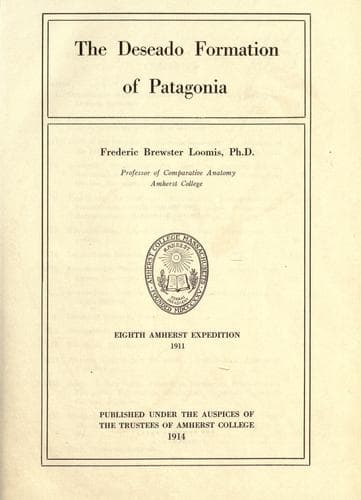
The Deseado Formation of PatagoniaLoomis, Frederic Brewster
Science
The Deseado Formation of Patagonia
Loomis, Frederic Brewster
Paleontology -- Patagonia (Argentina and Chile)
The distal portion of the humerus is preserved, showing the trochlea to
be relatively narrow, with a prominent internal phlange for the ulna.
The epicondyles are both small. The supratrochlear fossa is moderately
deep, the anconeal fossa very deep, a large perforation connecting the
two. Of the ulna, only the distal end is preserved, and it is marked
by a prominent styloid process, ending in the facet for the pyramidal,
this facet continuing uninterruptedly into that for the pisiform.
The two ends of the radius are preserved but its length can only be
conjectured. The proximal end has a large facet for the humerus; the
distal end two facets, for the scaphoid and luna respectively, the
two being almost continuous, except as the outline of the shallow
depressions is constricted near the middle.
The carpus is preserved _in toto_ and is decidedly weak for an animal
of this size, though no more so than is the case of Nesodon and
Adinotherium, with which forms the arrangement of the bones agrees
in almost every detail. The scaphoid has a broad facet on the upper
side for the radius, on the ulna side a narrow band-like facet for the
luna, and distally facets for the trapezoid and the magnum, none for
the trapezium. The luna is a larger bone with a broad radial facet
on the upper side, a narrow facet for the scaphoid on the radial
side, a larger one for the pyramidal on the ulnal side, and two broad
facets for the magnum and unciform on the lower side. The pyramidal
is a low, flattened bone, with a cup-like facet for the ulna on the
upper surface, an elongated flat facet for the pisiform on the palmar
surface, and below a broad facet occupying the entire lower side for
the unciform. The pisiform is shaped like a tiny calcaneum, and, beside
the facet for the pyramidal, has a broad contact on the styliform
process of the ulna. The trapezium is a flattened nodular bone, resting
against the side of the upper end of Mc. II, for which it has a
flattened contact surface, but it does not properly articulate with any
of the carpals. The trapezoid is a small bone, cuboidal in shape, with
the proximal facet for the scaphoid rounded, and with a narrow facet
for the support of Mc. II on the distal end. The magnum is a larger
bone, articulating proximally with the scaphoid and luna, on the ulnal
side with the unciform and distally supporting Mc. III. The unciform is
the largest of the carpal bones, articulates proximally on the luna and
pyramidal, on the radial side with the magnum, and distally carries Mc.
IV, while on the ulnal side there is a facet for the modular vestige of
Mc. V.
Public-domain text, read in full here on John Shaqi.
Reviews
Reviews
No reviews yet
Be the first to share your thoughts on this work.
Elsewhere in the archive
Join the Discussion
Join the discussion
Sign in to leave a comment or review.
Sign InorCreate an account