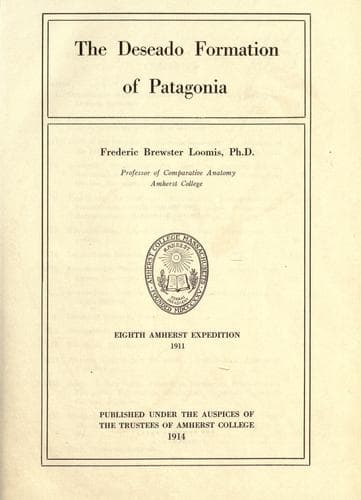
The Deseado Formation of PatagoniaLoomis, Frederic Brewster
Science
The Deseado Formation of Patagonia
Loomis, Frederic Brewster
Paleontology -- Patagonia (Argentina and Chile)
The skull is of moderate height, nearly flat on top with wide zygomatic
arches. The sagittal crest is moderately high, and slightly convex in
the antero-posterior direction. The occipital region is overhanging
and topped by short lambdoidal crests, which, extending to either
side, unite with the zygomatic arches. The nasals are large, roughly
rectangular, and slightly constricted just in front of the middle. The
frontals are short, and project over the orbits in strong processes.
The maxilla is large, bounding the front of the orbit, and extending
backward in a strong zygomatic process which makes nearly half of the
arch. The jugal, while stout, is short, and reaches from the long
zygomatic process of the maxilla to the short one of the squamosum.
The lachrymal bone is tiny, with a low tubercle, just below which is
situated the lachrymal duct, just on the margin of the orbit. Just
behind the zygomatic arch, the squamosum is inflated and contains
a large hollow chamber, as is typical among toxodonts. The mastoid
bullae, while relatively small, are swollen into a globular form, and
have a large hollow chamber. The palate extends back to just behind the
last molar, a feature distinguishing this genus from _Morphippus_.
Of the vertebral column, twenty-six vertebra are preserved (a few being
represented by neural arches only). The atlas and axis are unknown.
Five cervicals are present, each with a short, slightly opisthocoelus
centrum, and with low weak spines. The foramena for the vertebra artery
are usually large. Cervical 3 has a rather slender transverse process,
projecting down—and backward. On cervicals 4, 5 and 6, these lateral
processes are enlarged into broad lamellae, which reach their maximum
of size on the sixth. Cervical 7 has no lamella, simply a slender
transverse process. These transverse processes are strikingly like
those of Nesodon. The thoracic vertebrae (of which I have complete
or in parts 15) have moderately high spines, which resemble those of
Adinotherium, not only in the general build, but also in the presence
of a foramen for the exit of spinal nerves through each neural arch.
These foramena can not be referred to as adaptations, but are special
features indicating close relationship with the _Nesodontidae_. Six
lumbar vertebra are present, each having broad depressed centra, and
short wide spines. The rest of the column is unknown.
Public-domain text, read in full here on John Shaqi.
Reviews
Reviews
No reviews yet
Be the first to share your thoughts on this work.
Elsewhere in the archive
Join the Discussion
Join the discussion
Sign in to leave a comment or review.
Sign InorCreate an account