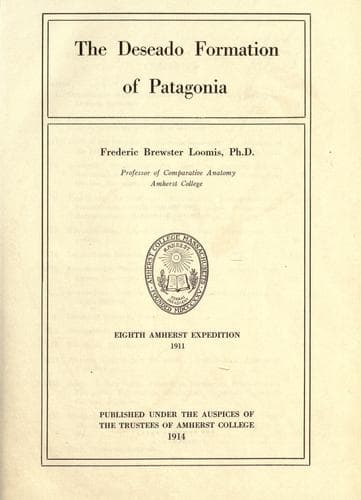
The Deseado Formation of PatagoniaLoomis, Frederic Brewster
Science
The Deseado Formation of Patagonia
Loomis, Frederic Brewster
Paleontology -- Patagonia (Argentina and Chile)
The atlas, axis and cervical 3 are associated with the skulls. The
atlas is short, heavy, and has the anterior cotyles broad, deeply
excavated and wide apart; while the posterior cotyles are nearly flat,
and high as well as wide. The transverse processes are only moderately
wide, but are very heavy, especially along the posterior margin. The
centrum of the axis is flattened, the neural canal, wider than high,
and the neural spine of moderate height. The anterior cotyles are broad
and moderately convex, and the odontoid process is a stout peg-like
process, somewhat higher than wide. Slender transverse processes
project sharply from the centrum, and have at their bases a large canal
for the vertebral artery. Cervical 3 is shorter than the axis, has a
less depressed centrum, a small neural spine, and short wide transverse
processes.
Though I have skulls and jaws to represent some twenty-five
individuals, no limb material was found in direct association with
any of them. However we did find a humerus, radius and ulna on the
same level and about fifteen feet from one of the skulls, and as it
corresponds in size, and as humeri of this type are the most abundant
skeletal bones found (as is also the case with the skulls), I have
considered it proper to associate these fore limb bones with these
skulls. The humerus is a stout bone, of medium length, with a large
sessile, and but little rounded head. The external tuberosity is
wide, thick and projects a little above the head, while the internal
tuberosity is so small as to be almost negligible. The shaft is
flattened laterally at the upper end, but distally is compressed in the
antero-posterior direction. The supratrochlear fossa is shallow, the
anconeal deep, but there is no foramen connecting them. The external
condyle is small, the internal much larger. The trochlea is narrow,
with a swollen articular area for the radius, and a wider saddle-like
one for the ulna. The ulna is a stout, nearly straight bone, slightly
longer than the humerus. The olecranon process, though large, is not
excessive. The sigmoid notch makes a deep semicircular cavity, with the
articular facets expanding on either side. It was closely fitted to
the radius so as to allow little or no rotary motion of the forearm.
The facet for the radius is a narrow band-like area just below the
sigmoid notch. The shaft is almost rectangular in section. Distally
the ulna contracts sharply into a heavy styloid process, on the end of
which is a large convex facet for the pyramidal, which merges without
interruption into the facet for the pisiform. The radius is a slenderer
bone, with a relatively small proximal head, but distally expanded into
a much larger articular end. My specimen is considerably weathered, but
shows a wide shallow articular facet for the humerus, and a band-like
facet for the ulna, but otherwise it gives little more than the length.
Public-domain text, read in full here on John Shaqi.
Reviews
Reviews
No reviews yet
Be the first to share your thoughts on this work.
Elsewhere in the archive
Join the Discussion
Join the discussion
Sign in to leave a comment or review.
Sign InorCreate an account