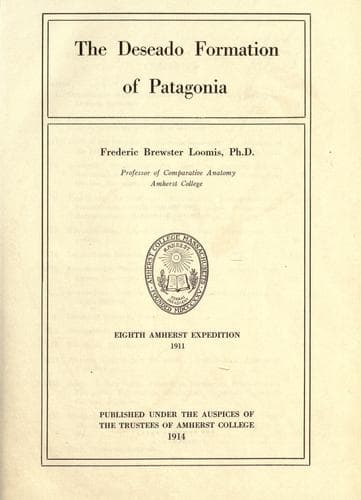
The Deseado Formation of PatagoniaLoomis, Frederic Brewster
Science
The Deseado Formation of Patagonia
Loomis, Frederic Brewster
Paleontology -- Patagonia (Argentina and Chile)
MEASUREMENTS
Upper dentition, molar 1, length 19 mm. @ Ameghino.
Upper dentition, molar 1, width 12 mm. @ Ameghino.
Upper dentition, m. 1 to m. 3, length 52 mm. @ Ameghino.
Lower dentition, premolar 2, length 13 mm. @ Ameghino.
Lower dentition, premolar 3, length 13 mm. @ Ameghino.
Lower dentition, premolar 4, length 17 mm. @ Ameghino.
Lower dentition, molar 1, length 18 mm., width 7 mm.
Lower dentition, molar 2, length 19 mm., width 7 mm.
Lower dentition, molar 3, length 20 mm., width 7 mm.
=Interhippus= Ameghino
Interhippus Amegh., 1904, Anal. Mus. Nac. Buenos Aires, ser. 3, t. 3,
p. 183.
Interhippus Amegh., 1904, Anal. Soc. Cienc. Argen., t. 56, p. 34 of
reprint.
This genus was established on isolated teeth which closely resemble
those of this family, though the genus was placed among the
_Rhynchippidae_ by Ameghino. The teeth described as molars are much
elongated and have the cristae greatly developed, and in one species
there is a style rising about the middle of the inner side of the
molar. Another feature emphasized as characteristic of this and the
next genus is, that the crowns are expanded much wider than the roots.
While there is not yet enough direct evidence to prove it, I feel that
this and the next genus will prove to be deciduous teeth, of either
_Proadinotherium_ or some related genus. Two species of this genus have
been described, both from the upper Deseado.
=I. phorcus= Amegh., loc. cit. above.
This species is characterized by its size, the last upper molar (so
called) measuring 16 mm. long by 14 mm. wide.
=I. deflexus= Amegh., 1904, Anal. Mus. Nac. B. A., ser. 3, t. 3, p. 183.
This species is based on a worn tooth designated as molar 1 (probably
d. pm. 3) 14 mm. long by 19 mm. wide.
[Illustration: Fig. 84. I. phorcus. “Upper molar 3”—natural size, after
Ameghino.]
[Illustration: Fig. 85. I. deflexus, “Upper molar 1”—natural size,
after Ameghino.]
[Illustration: Fig. 86. N. insulatus, “Upper molar 1”—natural size,
after Ameghino.]
=Nesohippus= Ameghino
Nesohippus Amegh., 1904, Anal. Soc. Cienc. Argen., t. 56, p. 34 of
reprint.
Nesohippus Amegh., 1904, Anal. Mus. Nac. B. A., ser. 3, t. 3, p. 218.
This genus is described as very like the foregoing, but differs in
having a strong perpendicular style on the anterior external face of
the upper molars. As in the preceding genus, the crown is considerably
expanded above the roots. I feel that this genus will also prove to be
the milk teeth of some one of the genera of this family. One species is
described, based on a single tooth.
=N. insulatus= Amegh., 1904, loc. cit. under the genus.
The species is just as described under the genus, the last upper molar
measuring 24 mm. long by 16 mm. wide; given as from the upper Deseado.
CHAPTER IX
ISOTEMNIDAE
Public-domain text, read in full here on John Shaqi.
Reviews
Reviews
No reviews yet
Be the first to share your thoughts on this work.
Elsewhere in the archive
Join the Discussion
Join the discussion
Sign in to leave a comment or review.
Sign InorCreate an account