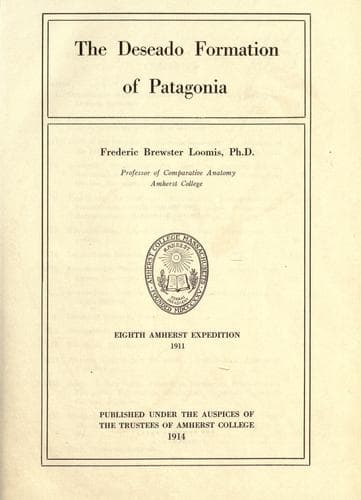
The Deseado Formation of PatagoniaLoomis, Frederic Brewster
Science
The Deseado Formation of Patagonia
Loomis, Frederic Brewster
Paleontology -- Patagonia (Argentina and Chile)
Femur, length (estimated) 480 mm.
Femur, width of distal end 135 mm.
Femur, width of trochlea 57 mm.
=Parastrapotherium ephebicum= Ameghino
P. ephebicum Amegh., 1895, Bol. Inst. Geog. Argen., t. 15, p. 639.
P. ephebicum Amegh., 1897, Bol. Inst. Geog. Argen., t. 18, p. 449.
P. lemoinei Amegh., 1895, Bol. Inst. Geog. Argen., t. 15, p. 640.
P. lemoinei Amegh., 1897, Bol. Inst. Geog. Argen., t. 18, p. 450.
Astrapotherium ephebicum Gaudry, 1904, Mem. Soc. Geol. France, t. 12,
p. 15.
Ameghino based this species on a portion of the mandible of an old
individual with molars 1 and 2. Its chief distinction lies in its small
size as compared with _P. holmbergi_. Gaudry assigned to this species
some upper teeth. We found no specimens of this species. The following
are the measurements of the type according to Ameghino.
Lower dentition, molar 1, length 31 mm., width 16 mm.
Lower dentition, molar 2, length 42 mm., width 21 mm.
=Parastrapotherium martiale= Ameghino:
P. martiale Amegh., 1901, Bol. Acad. Nac. Cordoba, t. 16, p. 402.
P. superabile Amegh., 1901, Bol. Acad. Nac. Cordoba, t. 16, p. 402.
[Illustration: Fig. 108. Upper molar 1 of the left side—natural size,
after Ameghino.]
The species seems to have been founded on abundant material,
representing an animal of larger size than _P. holmbergi_, which is
distinguished by the greater width of the crowns of the incisors, by
straight canines diverging but little, by a strong cingulum on the
outer side of the lower molars and the inner side of the upper molars,
and by the narrow symphysis of the lower jaws. _P. superabile_ was
distinguished by a difference in the arrangement of the roots of upper
pm. 4, but as the pattern of the crown is the same, as is also the
size, I feel that this difference is simply an individual variation.
The following measurements are given by Ameghino:
Upper dentition, length from pm. 3 to m. 3 240 mm.
Upper dentition, premolar 4, length 30 mm.
Upper dentition, premolar 4, width 43 mm.
Upper dentition, molar 2, length 82 mm.
Upper dentition, molar 2, width 83 mm.
Lower dentition, length from inc. 1 to m. 3 550 mm.
=Parastrapotherium insuperabile= Ameghino
P. insuperabile Amegh., 1901, Bol. Acad. Nac. Cordoba, t. 16, p. 403.
This is the largest of all the species, and is distinguished by the
enormous development of the cingulum on the anterior, inner, and
posterior sides of the upper molars, the same being uninterrupted and
so elevated, that the internal crests seem to rise out of a basin. The
following measurements are taken from Ameghino:
Upper dentition, premolar 4, length 37 mm., width 48 mm.
Upper dentition, molar 3, length 100 mm., width 80 mm.
Lower dentition, premolar 4, length 43 mm., width 23 mm.
CHAPTER XII
PROBOSCIDEA
Public-domain text, read in full here on John Shaqi.
Reviews
Reviews
No reviews yet
Be the first to share your thoughts on this work.
Elsewhere in the archive
Join the Discussion
Join the discussion
Sign in to leave a comment or review.
Sign InorCreate an account