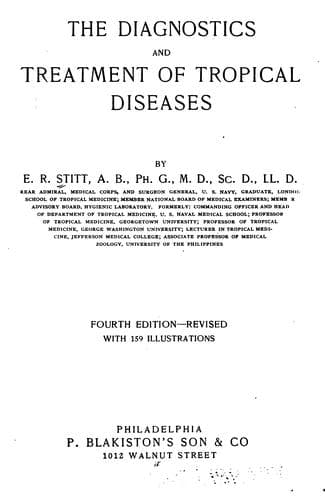
The diagnostics and treatment of tropical diseasesStitt, E. R. (Edward Rhodes)
Science
The diagnostics and treatment of tropical diseases
Stitt, E. R. (Edward Rhodes)
Tropical medicine
About the end of the 2d day the facial congestion disappears to
be succeeded by an earthy tinging and subicteroid tinting of the
conjunctivae. The jaundice does not appear until about the fourth
day. This may be noted somewhat earlier if one blanches the skin by
pressure with a glass slide. Petechial eruptions may be prominent
in the later stages. The jaundice is best seen at a distance of 5
to 6 feet.
_The Circulatory System._—Of peculiar value in diagnosis is
_Faget’s law_—a falling pulse rate with constant temperature or a
constant pulse rate with a rising temperature.
A markedly slow pulse, between 40 and 50, is often recorded about
the time of the period of remission.
It is interesting to note that the pulse of yellow fever made
a great impression upon Benjamin Rush, who called it the
indescribable or sulky pulse. The systolic blood pressure is high
at first, but by the 2d day begins to fall, becoming quite low in
the asthenic stage (even below 70 mm.) due probably to supra-renal
involvement rather than to cardiac weakness.
Haemorrhages, especially from gums, nose and intestines, are
common. Black vomit is the best known of these haemorrhages.
_Blood Examination._—This has generally been considered as varying
but slightly from normal findings.
Noc states that in the first stages of the disease there is
an increase of the polymorphonuclear percentage with a marked
diminution or disappearance of eosinophiles while later on,
from the 3d to the 6th day, there is an increase in the large
mononuclears.
_The Alimentary Tract._—The tongue may be coated in the
center. Vomiting often appears early and consists of whitish or
bile-stained mucus. It must be remembered that if black vomit
should appear it almost never comes on before the 4th day. There is
usually marked epigastric tenderness. Bleeding from the gums and
intestinal canal are not rare.
_The Nervous System._—The mind is unusually clear, the patient
often mentally alert and suspicious. There is often insomnia. The
severe cephalalgia, often frontal or supraorbital, as well as the
severe loin pains (_coup de barre_) are striking features. There
may be a marked hyperaesthesia. A delirious state may be present.
_The Liver and Spleen._—There is no special alteration in the
size of either liver or spleen. There may be tenderness about the
liver region. The jaundice of the asthenic stage is incident to
the pressure of the swollen degenerating liver cells on the bile
capillaries while the fatal issue is connected with the loss of the
urea formation function. It has been claimed that an acidosis may
occur. The spleen is not affected.
Public-domain text, read in full here on John Shaqi.
Reviews
Reviews
No reviews yet
Be the first to share your thoughts on this work.
Elsewhere in the archive
Join the Discussion
Join the discussion
Sign in to leave a comment or review.
Sign InorCreate an account