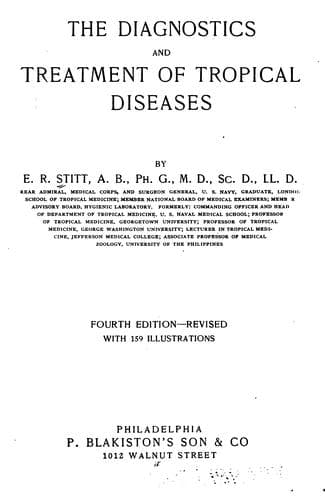
The diagnostics and treatment of tropical diseasesStitt, E. R. (Edward Rhodes)
Science
The diagnostics and treatment of tropical diseases
Stitt, E. R. (Edward Rhodes)
Tropical medicine
In infected guinea pigs there is swelling of the lymphatic glands
and the spleen with the presence of spirochaetes. The liver is
congested and may show a few spirochaetes. In human autopsies there
are degenerative changes in the liver and kidneys. The infection is
rarely fatal in experimental animals although it causes about a 10%
mortality in man.
SYMPTOMATOLOGY
Following a rather long incubation period of from six to eight weeks,
although cases have been reported where not more than two weeks had
elapsed from the time of injury, during which time the wound of
the rat bite heals, we have a rather sudden onset with headache,
nausea and marked weakness. The cicatrix now becomes inflamed and
the surrounding tissues show oedema and at times vesicle formation.
Leading from the inflamed areas is a line of tender lymphatics which
extend to a group of swollen lymphatic glands.
The onset is often characterized by chills and malaise. A rapid
pulse and prostration are present during the pyrexial period.
The fever rises rapidly to 101°F. or 102°F. and within two or three
days has reached about 104°F. and remains high for two or three more
days. About this time it falls rapidly to normal, attended with
profuse sweating. The temperature remains normal for a few days,
during which time the local swelling and inflammation subside. An
eruption of purplish spots may accompany the fever, appearing chiefly
on chest and arms. There may be urticarial lesions. Joint pains,
together with motor and sensory disturbances, may be noted.
Symptoms of nephritis may appear.
After the critical fall of temperature there is usually an
apyrexial period of several days during which time the local
manifestations about wound and glands subside. The fever again
comes on, to later disappear and reappear.
The successive paroxysms are usually of less severity.
The fever is suggestive of the relapsing fevers. The pulse is
rapid and weak. There may be as many as twelve of these febrile
accessions and the course of the disease may extend over several
months. There is an eosinophilia and during the febrile paroxysm
a leucocytosis of about 15,000. The spirochaetes should be looked
for in the blood during the early febrile periods. The dark-field
illumination is the best method for their demonstration.
TREATMENT
Treatment is entirely symptomatic. Some success seems to have
followed the administration of salvarsan.
Strychnine for the heart weakness and tonics during convalescence
are recommended.
Aspirin is often necessary to relieve the headache and joint pains.
As prophylactic measures the same precaution should be taken as to
cauterization of the wound as one would observe in rabies.
CHAPTER VIII
THE LEISHMANIASES
DEFINITION AND SYNONYMS
Public-domain text, read in full here on John Shaqi.
Reviews
Reviews
No reviews yet
Be the first to share your thoughts on this work.
Elsewhere in the archive
Join the Discussion
Join the discussion
Sign in to leave a comment or review.
Sign InorCreate an account