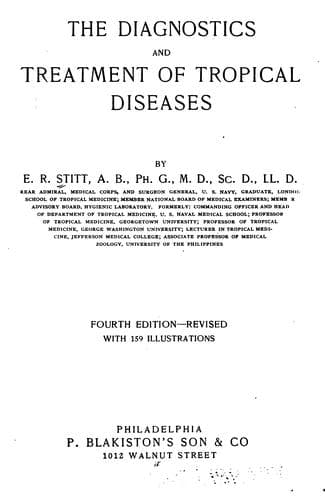
The diagnostics and treatment of tropical diseasesStitt, E. R. (Edward Rhodes)
Science
The diagnostics and treatment of tropical diseases
Stitt, E. R. (Edward Rhodes)
Tropical medicine
Formerly it was thought that there were differences in the three
species of _Leishmania_ from the standpoint of growth on various
culture media, _L. donovani_ not growing on N. N. N. medium while _L.
infantum_ grew well on N. N. N. medium but not in citrated blood. It
is now known that both species will grow on these two media.
It is absolutely essential in culturing _L. donovani_ or _L.
infantum_ that the blood agar or citrated blood be sterile, as
any bacterial contamination prevents growth. With the parasite
_L. tropica_, however, bacterial contamination does not inhibit
development and statements have even been made that growth is
favored by a staphylococcal symbiosis. _L. tropica_, it would seem,
will develop into flagellated forms in cultures at 28°C. while it
will be remembered that Rogers in his original experiments failed
to obtain other than commencing signs of division at 27°C., 22°C.
being the temperature necessary for the development of flagellate
forms.
_L. tropica_ from South American cutaneous leishmaniases seems to
grow more luxuriantly on N. N. N. medium than does that of oriental
sore of Asia and Africa.
Giugni tried N. N. N. media made with human, rabbit and dog blood,
respectively. The parasites grew well on dog and rabbit blood media
but not on that made with human blood. He found growth best when
he added salt in quantity from 5 to 9 grams per liter. When red
corpuscles are laked in a medium the growth is less favorable.
While differences in development on different culture media may
obtain not only with different species but with different strains
of the same species, it would appear that such variations cannot be
utilized as a means of separating the three species.
_Animal Inoculation._—With animal inoculations we formerly thought
that the parasite of kala-azar could be differentiated from that of
infantile leishmaniasis by the fact that dogs could not be infected
with _L. donovani_, while they were susceptible to infections
with _L. infantum_. Recently Donovan and Patton have successfully
inoculated dogs with kala-azar splenic material. Patton found the
parasites in the liver, spleen and lymphatic glands as well as bone
marrow of the inoculated dogs. Consequently we cannot separate the
two visceral leishmaniases from a standpoint of susceptibility
of the dog. Monkeys are susceptible to both diseases. It is
important to recognize the fact that animal inoculations, even with
spleen-juice, rarely give rise to infection.
Public-domain text, read in full here on John Shaqi.
Reviews
Reviews
No reviews yet
Be the first to share your thoughts on this work.
Elsewhere in the archive
Join the Discussion
Join the discussion
Sign in to leave a comment or review.
Sign InorCreate an account