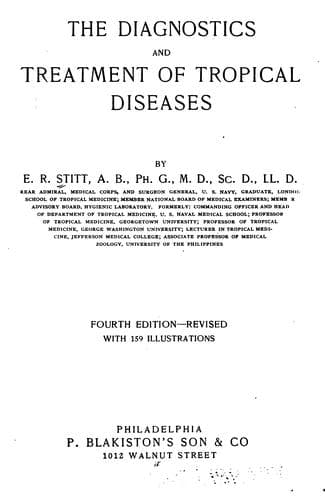
The diagnostics and treatment of tropical diseasesStitt, E. R. (Edward Rhodes)
Science
The diagnostics and treatment of tropical diseases
Stitt, E. R. (Edward Rhodes)
Tropical medicine
Kartulis continued the work of Koch and in 1886 published his
findings in 150 cases of dysentery, noting the presence of amoebae
in the stools of all these cases. In 1887 he noted the presence
of amoebae in liver abscess. In 1891, Lutz noted that amoebae in
dysentery contained red cells. In the same year Councilman and
Lafleur came to the conclusion that there were two species of
amoebae in man, one harmless and the other, which was found in
the submucosa of intestinal ulcers, pathogenic, Casagrandi and
others put forward the view that amoebae only acted as carriers for
bacteria, but in 1893 Kruse and Pasquale injected all the bacterial
species isolated from a dysenteric stool into a cat’s rectum with
negative result. Hlava and Kartulis first produced dysenteric
lesions in cats by injecting per rectum, amoebic stools. Kruse
and Pasquale produced dysentery in cats by injecting per rectum
bacteria-free pus from a liver abscess which however contained
amoebae.
A stumbling block as to the connection between amoebae and
dysentery was the fact that many cases of typical dysentery failed
to show amoebae. In 1898 Shiga settled this matter by reporting
a group of bacilli which were concerned in the production of
dysentery. His findings were confirmed all over the world and the
distinction gradually obtained of cases of dysentery from bacillary
as well as from amoebic infections.
In 1903 Schaudinn reported the existence of two species of amoebae,
one harmless and named _Entamoeba coli_, the other pathogenic and
named _E. histolytica_. In 1907 Viereck described a pathogenic
amoeba which, by reason of its four nuclei in the encysted stage,
he called _E. tetragena_.
As the result of the work of Hartmann, Whitmore, Darling, Wenyon and
the recent conclusive findings of Walker we now hold the view that
Schaudinn was working with _E. tetragena_ and not with a separate
species, so that by the law of priority we must drop the name _E.
tetragena_ and accept _E. histolytica_.
=Geographical Distribution.=—Amoebic dysentery seems to be
especially prevalent in Indo-China, China and the Philippines, as
well as in parts of India. It is also very common in Egypt and
Northern Africa. In South America, especially Brazil, it is common,
as is also true of the West Indies and Central America. It is an
important disease in the Southern States of the United States, as
well as in Italy and other parts of Southern Europe. On the whole
it is probable that it exists in greater or less degree in most of
the tropical and subtropical parts of the world.
ETIOLOGY AND EPIDEMIOLOGY
Public-domain text, read in full here on John Shaqi.
Reviews
Reviews
No reviews yet
Be the first to share your thoughts on this work.
Elsewhere in the archive
Join the Discussion
Join the discussion
Sign in to leave a comment or review.
Sign InorCreate an account