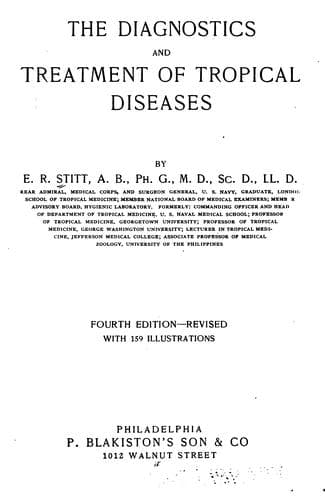
The diagnostics and treatment of tropical diseasesStitt, E. R. (Edward Rhodes)
Science
The diagnostics and treatment of tropical diseases
Stitt, E. R. (Edward Rhodes)
Tropical medicine
Of the functional liver tests we may determine the ammonia
quotient, the percentage of N eliminated as ammonia being increased
in abscess of the liver. The same is true of the lipase test.
Probably the most specific test for disturbances of the hepatic
function is that for urobilinogen. The test is made by adding 5 to
10 drops of Ehrlich’s aldehyde reagent to 5 cc. of perfectly fresh
urine when a positive reaction gives a fine cherry-red color.
PROPHYLAXIS AND TREATMENT
=Prophylaxis.=—The prophylaxis is the same as that for amoebic
dysentery plus avoidance of anything which reduces the functional
power of the liver, such as overfeeding, alcoholic excesses, etc.
It is well to remember that abscesses may occur months or even two
or three years after an attack of amoebic dysentery, consequently
it is well to give a grain of emetine on two or three successive
days of each month following an acute attack.
=Treatment.=—Leaving out of consideration the pre-suppurative stage
of amoebic hepatitis which, according to many authorities, responds
to injections of emetine, it may be stated that the treatment of
liver abscess is entirely surgical and such treatment should be
instituted the moment the diagnosis is made. The earlier a liver
abscess is drained the less run down will be the patient, the more
rapid the convalescence and the better the prognosis.
Until recently surgical authorities condemned severely the trocar
and cannula method of operation, but with the introduction of
emetine there are now those who believe that such a procedure may
suffice and a more radical operation not be necessitated.
Prior to introducing the trocar and cannula the usual procedure
is to use an aspirating needle of about ⅛ inch bore and 3½ inch
length. If the needle happens to be longer it should not be passed
deeper than 3½ inches, in a person with a 32-inch chest, in order
surely to avoid the vena cava. If there are no distinct localizing
signs the needle should first be introduced in the eighth or ninth
interspaces in the anterior axillary line and pushed backward,
inward and slightly upward. Manson recommends at least 6 punctures
before abandoning exploration. Cantlie does not think that a
moderate degree of haemorrhage from the puncture of the liver will
do harm in a case which is simply a liver congestion. One should
always be ready to operate in case pus be found in the exploring
needle. Leaving the needle in situ a small skin incision is made
and a 4 or 5 inch by ⅜ inch trocar and cannula introduced along
the line of the needle. Withdrawing the trocar some of the pus is
allowed to escape through the cannula and there is then introduced
a 6 × ½ inch piece of strong rubber drainage tubing, one end of
which has lateral fenestrations but a closed tip in order that a
long steel pin may put the tubing on the stretch so that it passes
the smaller lumen of the cannula.
Public-domain text, read in full here on John Shaqi.
Reviews
Reviews
No reviews yet
Be the first to share your thoughts on this work.
Elsewhere in the archive
Join the Discussion
Join the discussion
Sign in to leave a comment or review.
Sign InorCreate an account