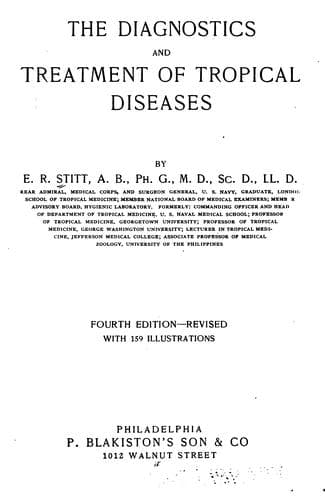
The diagnostics and treatment of tropical diseasesStitt, E. R. (Edward Rhodes)
Science
The diagnostics and treatment of tropical diseases
Stitt, E. R. (Edward Rhodes)
Tropical medicine
The characteristic of nonmotility is of greatest differentiating
value and the reports of slight motility are probably from
misinterpretation of molecular movement as motility. The dysentery
bacilli do not form those thread or whip-like filaments so
characteristic of typhoid cultures and are somewhat plumper. The
dysentery bacillus is not found in the blood and hence is not
eliminated in the urine, although recently there have been reported
rare cases where dysentery bacilli were isolated from the blood. It
is found in mesenteric glands. In dysentery patients agglutination
phenomena do not show themselves until about the tenth day from
the onset. Hence, this procedure is of no particular value in
diagnosis. It is of value, however, to identify an organism
isolated from the stools at the commencement of the attack, using
serum from an immunized animal or a human convalescent for the
agglutination test.
There seems to be only moderate agglutination power in the serum
of convalescents from Shiga strains. Flexner strains give higher
agglutinations, but early in convalescence the serum is not apt to
have a titre of more than 1-150.
Dysentery bacilli produce a coagulation necrosis of the mucous
membrane of the large intestine and occasionally of the lower
part of the ileum. Polymorphonuclears are contained in the fibrin
exudate.
It was formerly thought that these lesions were of local origin,
but the present view is that toxins are produced which, being
absorbed, are eliminated by the large intestine with resulting
necrosis. Flexner, by injecting rabbits intravenously with a toxic
autolysate, produced characteristic intestinal lesions. The toxin
withstands a temperature of 70°C. without being destroyed. The
toxin may cause joint trouble.
There are two main types of dysentery bacilli:
1. Those producing acid in mannite media—the acid strains
(Flexner-Strong types).
2. Those not developing acid in mannite (Shiga-Kruse types). The
Shiga type is very toxic in cultures, while the Flexner type seems to
be less so. An organism resembling the Shiga bacillus but producing
indol is the Schmitz bacillus. It does not appear to be pathogenic.
In immunizing horses for the production of antidysenteric serum it
is customary to use both Flexner and Shiga strains, thus producing
a polyvalent serum.
Lentz recognizes 4 types of dysentery bacilli for the
differentiation of which he uses mannite, maltose and saccharose
bouillon with litmus as an indicator.
------------+-------------+---------+--------+-------
| Shiga-Kruse | Flexner | Strong | “Y”
------------+-------------+---------+--------+-------
Mannite | Blue | Red | Red | Red
Maltose | Blue | Red | Blue | Blue
Saccharose | Blue | Blue | Red | Blue
------------+-------------+---------+--------+-------
Public-domain text, read in full here on John Shaqi.
Reviews
Reviews
No reviews yet
Be the first to share your thoughts on this work.
Elsewhere in the archive
Join the Discussion
Join the discussion
Sign in to leave a comment or review.
Sign InorCreate an account