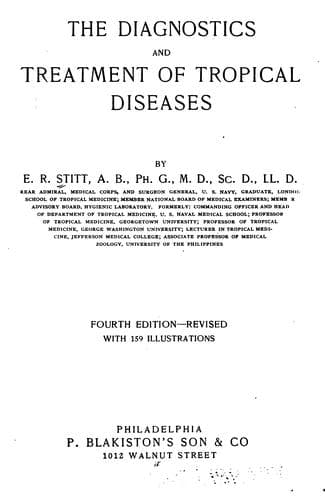
The diagnostics and treatment of tropical diseasesStitt, E. R. (Edward Rhodes)
Science
The diagnostics and treatment of tropical diseases
Stitt, E. R. (Edward Rhodes)
Tropical medicine
In the tropics and in temperate climates where the Shiga type
bacillus is the infecting organism the onset is usually rather
sudden with malaise, abdominal pain and a diarrhoea, which only
temporarily relieves such pain. This initial diarrhoea is soon
followed by the characteristic dysentery stool and the pains, which
latter tend to centre about the umbilicus and to become continuous.
There is usually loss of appetite and slight nausea and the patient
may at times show a very slight tendency to flightiness. The mind
however is usually clear. Fever of moderate degree is not uncommon
and it may be quite marked,—up to 104°F. Ingestion of food or
drink or any movement of the body brings on a desire for defecation.
The number of stools, which in mild cases number 15 to 30, may become
excessive, even more than one hundred in twenty-four hours, and the
tenesmus most torturing, so that excoriations around the anus and
at times prolapse of the bowel intensify the distressing clinical
picture. In acute cases the stool may be almost pure blood with only
an admixture of mucus.
Vesical tenesmus may be present and the urine may be diminished in
amount.
There is a toxic effect on the heart so that the pulse tends to
become accelerated and weak. Bacillary dysentery may show a moderate
leucocytosis with increased polymorphonuclear percentage instead of a
large mononuclear one as with amoebic dysentery.
At times, however, the lymphocytes may be the leucocytes showing
the greatest relative increase.
_Collapse Types._—In the most severe types of dysentery we may have
an abrupt onset with rigors and vomiting and a high fever. This fever
gives way to a subnormal temperature and the patient shows signs of
collapse and such a case may die without having passed dysenteric
stools. The abdomen is rigid and very tender on palpation.
_Entero-dysentery._—In those cases where the process extends to
the lower portion of the small intestine the general symptoms are
much more severe although the tenesmus is less and the stools less
frequent and more voluminous. They contain much blood and mucus mixed
with feculent material. Shiga calls such cases entero-dysentery.
In severe cases of the more typical dysentery or colodysentery, as
designated by Shiga, the stools may change from the mucopurulent
mass to a serous discharge which is very rich in albumin and of an
albuminous odor. In such cases emaciation of the patient is very
rapid. Such cases may show signs of collapse with cold clammy skin
and the clinical picture one associates with cholera.
It has been suggested that such cases may be due to action of the
dysentery toxins on the adrenal.
This serous fluid may contain the flesh-like particles which the
French liken to gut scrapings. During convalescence there may be an
arthritis, which however does not impair the function of the joint.
Public-domain text, read in full here on John Shaqi.
Reviews
Reviews
No reviews yet
Be the first to share your thoughts on this work.
Elsewhere in the archive
Join the Discussion
Join the discussion
Sign in to leave a comment or review.
Sign InorCreate an account