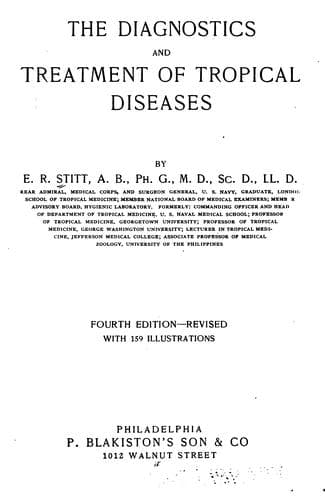
The diagnostics and treatment of tropical diseasesStitt, E. R. (Edward Rhodes)
Science
The diagnostics and treatment of tropical diseases
Stitt, E. R. (Edward Rhodes)
Tropical medicine
Both of these types of plague tend finally to show an invasion
of the blood stream with plague bacilli, the case then becoming
one of septicaemic plague. Many authors, however, recognize an
overwhelming plague septicaemia in which the manifestations of
buboes or pneumonia are absent and such cases are designated
septicaemic plague, or _pestis siderans_.
In all forms of pestis major there stand out the characteristics of
rather sudden onset, rigors or chilly sensations, rapidly rising but
irregular fever, marked giddiness, great prostration, the mental
state and speech of an intoxicated person and extreme weakness of the
heart with a rapid weak pulse.
Typhus fever alone shows an equal degree of early mental hebetude,
so that it is stated that Clot Bey, who had seen much plague
in Egypt, when elsewhere shown cases of typhus with parotid
involvement, remarked “In Egypt one would call such cases plague.”
=A Typical Case of Bubonic Plague.=—After a period of incubation
of from three to seven days the disease may set in quite abruptly,
or after a prodromal stage, in which malaise, giddiness, mental
hebetude and pains in the back and limbs may be present. With the
onset of the attack the effects of the toxaemia upon the nervous
system are the most striking. The patient has a pale, drawn, anxious
countenance, with injection of the conjunctivae toward the inner
canthus.
The speech is thick and difficult, the gait is staggering, so that,
with the stupid mental state and tendency to wander aimlessly
about, one has the symptom-complex of an alcoholic intoxication. In
some cases a delirious tendency may be marked, especially as the
disease develops. After a few hours, or within a day, the fever
begins to rise rapidly and is often associated with shivering
attacks. The face now becomes hot and flushed, the conjunctivae
markedly injected, the pupils dilated, and the eyes rather staring.
The temperature is as a rule from 102° to 104°F., occasionally
higher, with a tendency to rather marked remissions and, on the
whole, of great irregularity of the fever curve. The pulse is rapid
and shows early indications of the extreme toxic effect exercised
upon the heart. Cardiac weakness is a marked feature of plague.
The urinary secretion is diminished but there is rarely more than a
slight amount of albumin.
_The Pathognomonic Bubo._—About the second or third day the
development of an extremely painful bubo practically gives the
diagnosis.
About 70% of these buboes are of the inguinal region, the femoral
glands being more frequently invaded than those above Poupart’s
ligament. The axillary glands are involved in about 20% and the
submaxillary and cervical ones in from 5 to 10% of cases.
Public-domain text, read in full here on John Shaqi.
Reviews
Reviews
No reviews yet
Be the first to share your thoughts on this work.
Elsewhere in the archive
Join the Discussion
Join the discussion
Sign in to leave a comment or review.
Sign InorCreate an account