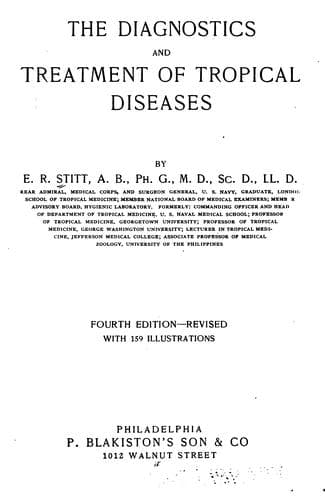
The diagnostics and treatment of tropical diseasesStitt, E. R. (Edward Rhodes)
Science
The diagnostics and treatment of tropical diseases
Stitt, E. R. (Edward Rhodes)
Tropical medicine
An influenza pneumonia may show the general prostration and cardiac
weakness of plague. In influenza pneumonia we have an onset
with the features of ordinary influenza, which, however, in the
influenza epidemic in 1918 was often short. In plague pneumonia
we have pneumonia from the start. The pulse in plague is early
weak and rapid and the tendency to a stuporous state more marked.
The early appearance of thin watery sputum, which quickly becomes
blood-tinged and always contains plague bacilli is noted in plague
pneumonia. Only a few hours elapse before we have bloody sputum
which in influenza is a later and not constant sign. The dyspnoea
is earlier and much more pronounced in the pneumonic plague. At
autopsy Crowell notes the almost invariable presence of pleural
exudates in plague while an acute vesicular emphysema is a feature
of influenza pneumonia.
Malaria and septicaemic conditions may be confused with septicaemic
plague. The sudden onset and prostration of relapsing fever may
make one think of plague.
Many have thought climatic bubo a form of ambulant plague but the
gradual onset, only slight tenderness of the swollen glands and
slight prostration should differentiate. Venereal bubo cases are
apt to be regarded with suspicion during epidemics.
Markedly toxic cases of typhoid fever with an exceptionally rapid
onset may give rise to confusion.
=Laboratory Diagnosis.=—If the patient has a bubo we should
introduce a hypodermic syringe needle into the swollen, oedematous
glandular mass in order to obtain some of the gland juice. Smear a
drop of this on a slide, stain with Loeffler’s blue or dilute carbol
fuchsin and examine for bipolarly stained oval bacilli. When the bubo
begins to soften we may not obtain plague bacilli.
Probably the best stain for plague bacilli is that recommended by
Archibald. There are two solutions, one made by dissolving 0.5 gram
of thionin and 2.5 grams phenol crystals in a 1% aqueous solution of
formalin; the other solution is made by dissolving 0.5 gram methylene
blue and 2.5 grams phenol crystals in a 1% formalin solution. Let
these stock solutions stand 24 hours before using and then mix equal
parts of each solution; filter, and stain smear for 10 seconds. Wash
and dry.
In a case of suspected pneumonic plague we stain the smear of
watery or thin blood-tinged sputum as above.
The same procedure may be followed with a rather heavy blood smear of
a drop of the 5 or 10 cc. taken from a vein for culturing in a case
suspected of septicaemic plague.
Public-domain text, read in full here on John Shaqi.
Reviews
Reviews
No reviews yet
Be the first to share your thoughts on this work.
Elsewhere in the archive
Join the Discussion
Join the discussion
Sign in to leave a comment or review.
Sign InorCreate an account