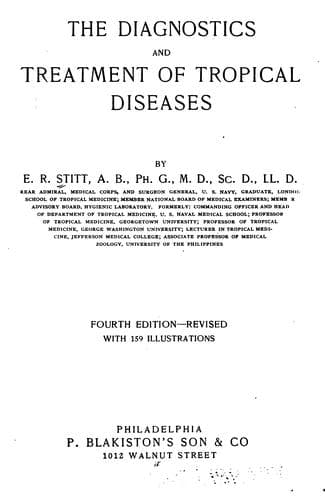
The diagnostics and treatment of tropical diseasesStitt, E. R. (Edward Rhodes)
Science
The diagnostics and treatment of tropical diseases
Stitt, E. R. (Edward Rhodes)
Tropical medicine
Agglutination is not very practical owing to the frequent absence
of agglutinins from the serum of plague patients. Then, too, there
is a marked tendency to spontaneous agglutination on the part of
the plague bacilli. Strong states that culturing at 37°C. lessens
this tendency to spontaneous agglutination. Again, even when
present, the titre of plague-agglutinating sera is usually quite
low so that one must work with dilutions of from 1 to 10 or 1 to 20.
PROGNOSIS
Pneumonic and septicaemic plague give an almost absolutely
unfavorable prognosis, many stating that every such case dies.
As regards bubonic plague the mortality averages 75%. The Egyptian
epidemic of 1900 gave an average mortality of 50%. The mortality
in natives is much higher than that among Europeans, these latter
often showing death rates under 25% while in the same epidemic
natives show from 75% to 95% mortality. Plague pneumonia, however,
is absolutely fatal for Europeans as well as natives.
PROPHYLAXIS AND TREATMENT
=Prophylaxis.=—In pneumonic plague it is the human patient and not
the rat which has to be considered. The infection is spread by means
of droplets of plague bacilli-laden sputum which are sprayed from the
mouth of the patient in the act of coughing. As a result any person
entering a ward containing plague pneumonia cases is extremely liable
to contract the pneumonic form of plague.
The attendants are protected by bag-like masks or successive layers
of gauze and cotton wool applied as bandages over face and neck.
Motoring goggles make a good protection for the eyes and small
rolls of cotton should be placed along the sides of the nose to
absolutely prevent the possibility of bacilli being drawn down to
the entrance of nose or mouth. These masks should not have any weak
spot in their armor.
_Spread of plague pneumonia_.—It has been noted that when
secondary pneumonia develops in the course of bubonic plague in
India, the Philippines, or other hot countries, it is not followed
by primary plague pneumonia outbreaks. This is thought to be due to
the fact that the windows are wide open and the relative humidity
low, conditions which are the opposite of those which existed
in Manchuria where the intense cold made the closing of windows
necessary and where the air of rooms or wards was saturated with
the moisture from the occupants. As the main consideration for the
spread of pneumonic plague seems to be high relative humidity it
would seem that hospital wards could be constructed so that the air
supplied by artificial ventilation would be very dry.
The recent outbreak of septicaemic plague in Ceylon at a time
when there was no plague noted in rats would indicate that other
transmitting agents than infected rat fleas were operative. The most
probable transmitting insects to be suspected would be the bedbug and
human flea.
Public-domain text, read in full here on John Shaqi.
Reviews
Reviews
No reviews yet
Be the first to share your thoughts on this work.
Elsewhere in the archive
Join the Discussion
Join the discussion
Sign in to leave a comment or review.
Sign InorCreate an account