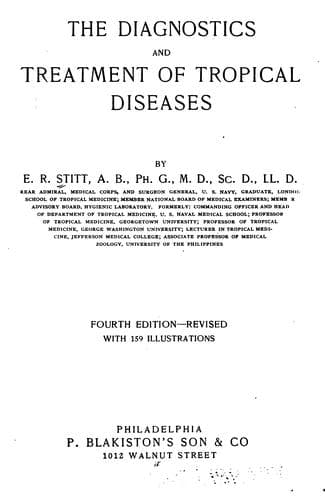
The diagnostics and treatment of tropical diseasesStitt, E. R. (Edward Rhodes)
Science
The diagnostics and treatment of tropical diseases
Stitt, E. R. (Edward Rhodes)
Tropical medicine
Where rats are on board ship fumigations with sulphur dioxide, carbon
monoxide or funnel gases are usually employed.
Hydrocyanic acid gas is a most efficient destroyer of rat and flea
life. The great objection to its use is its danger to those using
it in fumigation. Liston allows this gas, developed from ½ ounce
KCN, to act for four hours in a space of 100 cubic feet. The great
danger from the use of this gas in holds of ships is that it tends
to collect in detached spaces or pockets and remains following
ventilation of the hold so that persons entering such spaces
suffer the poisonous effects of the gas. Some cargo ships have a
rat-run built to extend fore and aft and leading to a receptacle
in which the rats are caught. Rats naturally choose a tube or
similar opening so they get into this little passageway which is so
constructed that their return is obstructed. This scheme is used
in setting traps, either covering the traps with hay and leaving
a small opening or placing the trap under an inclined plank or
placing it at the end of an iron or terracotta pipe. There is not
much danger of rats getting aboard a ship lying out from the dock.
It is when a ship goes alongside a dock that we can expect rats to
come aboard.
Phosphorus paste made up with a glucose base and containing about
4% of phosphorus is spread on pieces of stale bread, 1 inch square
and ¾ inch thick. Whatever poison is used, whether strychnine,
arsenic or phosphorus, it should be placed in boxes which have
openings large enough to let the rats in but too small for
domesticated animals. Barium carbonate is a useful rat poison.
Cats will very rarely attack the fierce sewer rat.
_Danysz virus._—Many workers, during plague outbreaks, have tried
to exterminate rats by impregnating bread or other bait with
bacterial cultures. The best known of these viruses, as they are
called, is that of Danysz. The organism is closely related to _B.
enteriditis_ of Gaertner and is supposed to bring about a fatal
infection in the rats. As a matter of fact the cultures quickly
cease to be virulent and their use has been generally abandoned.
Simpson, however, thinks well of this measure and employed it with
success in South Africa. He kept up the virulence of his cultures
by frequent passage through animals.
In rat extermination it is advisable to employ Heiser’s Manila plan.
In this, the location in the city of the plague rats brought into
the laboratory is noted and radiating lines made from such foci.
Plague-infected rats are rarely found more than a few squares from
the focus. The periphery of the infected area is then considered as
an outer zone for the fight and the house-to-house extermination is
carried on toward the center of the area. If, on the other hand, one
should start at the center and work peripherally the infected rats
might be spread all over the city.
Public-domain text, read in full here on John Shaqi.
Reviews
Reviews
No reviews yet
Be the first to share your thoughts on this work.
Elsewhere in the archive
Join the Discussion
Join the discussion
Sign in to leave a comment or review.
Sign InorCreate an account