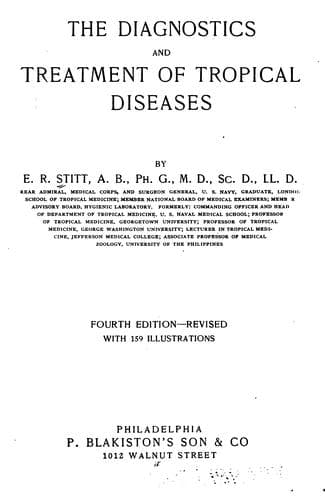
The diagnostics and treatment of tropical diseasesStitt, E. R. (Edward Rhodes)
Science
The diagnostics and treatment of tropical diseases
Stitt, E. R. (Edward Rhodes)
Tropical medicine
It is well to first make a microscopical examination of the stool
by taking one of the whitish epithelial flakes from the rice-water
material and making a straight smear which is then dried and fixed
with heat. This may be stained best by a dilute carbol fuchsin (1
to 10). Methylene blue makes a good stain, or more differential
is that by Gram’s method which shows the Gram-negative spirilla
stained by the bismarck brown counterstain, giving the appearance
of fish parallel to one another in a stream. According to Koch a
diagnosis can be made in this way of one-half the cases during an
epidemic.
The scintillating motility of cholera spirilla may strike one in the
examination of the stool in hanging drop.
Dunbar has a quick diagnostic method in which epithelial flakes
from the stool are emulsified in peptone solution. Then on a
slide, according to the method to be later described, is deposited
a drop of 1 to 50 normal serum dilution and on the same slide a
second drop of 1 to 500 dilution of cholera serum. A loopful of
the suspected stool emulsion is rubbed up in each of these serum
dilutions and we should have cessation of motility and clumping in
the cholera immune serum provided the organisms in the stool are
true cholera spirilla.
In case of an autopsy on a suspected case of cholera one should
tie off, between double ligatures, at least two 5-inch sections
of small intestines, one just above the ileo-caecal valve and one
taken from about the middle of the ileum. These portions of gut
should be dropped into sterile salt mouth bottles, well stoppered
and sent to a bacteriological laboratory as soon as possible. As
the cholera spirilla, when associated with faecal bacteria, tend
to die off within twelve to twenty-four hours it would probably be
advisable to inoculate an agar or blood serum slant with material
from the ileum at the same time the sections of gut are removed.
For diagnosis of a cholera carrier with a normal stool or a cholera
suspect with a diarrhoeal one inoculate 2 or 3 tubes of peptone
solution with 2 or 3 loopfuls of material from the stool. With
suspected carriers who are constipated and to whom one should not
give purgatives we may insert into the rectum a rubber tube or a
throat swab in order to obtain material immediately. The cholera
spirilla grow rapidly and being strong aerobes, they grow on the
surface of the fluid so that by taking a loopful from the surface,
we may in three to eight hours obtain a pure culture. Should there
be a pellicle present, this should be avoided in transfer by
tilting the tube slightly, so that the material near the surface
be obtained without touching the pellicle. Inoculate a second
tube from the surface of this first and, if necessary, a third
(_enrichment method_).
Public-domain text, read in full here on John Shaqi.
Reviews
Reviews
No reviews yet
Be the first to share your thoughts on this work.
Elsewhere in the archive
Join the Discussion
Join the discussion
Sign in to leave a comment or review.
Sign InorCreate an account