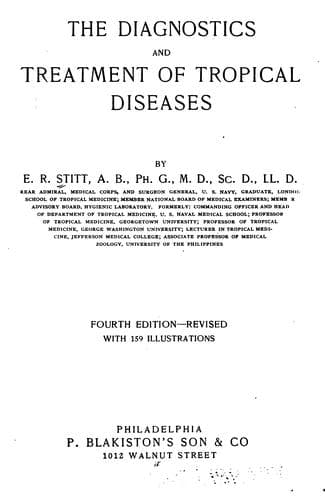
The diagnostics and treatment of tropical diseasesStitt, E. R. (Edward Rhodes)
Science
The diagnostics and treatment of tropical diseases
Stitt, E. R. (Edward Rhodes)
Tropical medicine
If conditions are such that boiled water cannot be obtained the
water may be treated with good quality chlorinated soda. As a
stock solution we use 1 teaspoonful of chlorinated soda to 1 pint
of water and of this 1 teaspoonful to 2 gallons of the water
to be disinfected. Pottevin recommends six hours contact with
hypochlorite of soda, 1 mg. per liter.
Besides care of the food and water ingested particular attention
should be paid to the washing of the hands before eating and if in
contact with cholera cases careful disinfection of the hands.
Experience in cholera epidemics has shown the importance of avoiding
anything which might lower resistance. In particular are fatigue,
excesses in alcohol or the taking of any kind of indigestible foods
to be avoided. It must be remembered that the use of purgatives may
set up cholera in a cholera carrier so that this possibility should
be thought of.
Tea has been recommended as a prophylactic, as has also eucalyptus
oil, 10 minims twice daily.
As acids have an inimical effect on the cholera spirilla some have
recommended the use of acid drinks but as a matter of fact the best
prophylactic is the normal gastric juice and there is a possibility
that the use of such acid drinks might upset the digestion and thus
defeat the object desired.
As to municipal measures for the control of a cholera outbreak the
most important one is to diagnose cholera carriers, such cases often
occurring in those associated with a cholera case. Such carriers
should be isolated and their stools disinfected until at least
2 negative examinations show them to have ceased being cholera
carriers. Of course a cholera case should be isolated and kept in a
fly-screened room.
For disinfection of stools one requires an equal amount of a 5%
compound cresol solution which when mixed with the same amount of
stool becomes a 2½% solution. This should be in contact with the
stool at least one hour before emptying the container. Chlorinated
lime, 1 pound to 4 gallons, makes a splendid disinfectant for
stools—equal parts of this 1 to 16 chlorinated lime solution and
stool.
Bed clothing or other material contaminated by vomitus or faeces
should be immersed in a 2½% compound cresol solution. All food
utensils should be disinfected by boiling.
Persons attending cholera cases should wear gowns and remove the
same upon leaving the room. Particular care should be exercised in
hand disinfection after attending a cholera case.
There is no danger from aerial conveyance of infectious material
other than the possibility of one’s coming within the danger zone
of a vomiting patient. Therefore, for disinfection of a room
occupied by a cholera patient we need not use formaldehyde gas but
washing of floors and lower part of walls with 2½% compound cresol
solution is sufficient. The stock solution of chlorinated lime, 1
pound to 4 gallons, is suitable for mopping floors and walls.
Public-domain text, read in full here on John Shaqi.
Reviews
Reviews
No reviews yet
Be the first to share your thoughts on this work.
Elsewhere in the archive
Join the Discussion
Join the discussion
Sign in to leave a comment or review.
Sign InorCreate an account