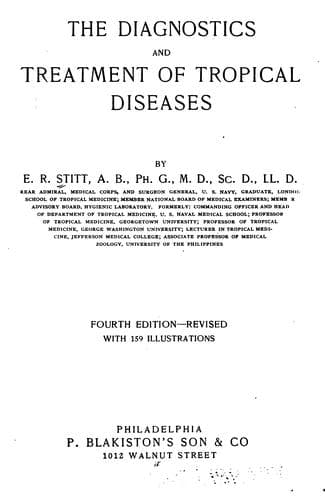
The diagnostics and treatment of tropical diseasesStitt, E. R. (Edward Rhodes)
Science
The diagnostics and treatment of tropical diseases
Stitt, E. R. (Edward Rhodes)
Tropical medicine
Bassett-Smith recommends an autogenous vaccine, during the afebrile
period, in doses of from 50 to 200 millions. He thinks that the
best results are obtained with sensitized vaccines. During acute
phases the vaccine treatment is detrimental—it is only in chronic
cases that such treatment is of value. Some prefer to give doses of
10 million or so at short intervals. He also thinks yeast in 2-dram
doses to be of value. Phenacetin or aspirin may be given, but the
heart weakness makes extensive use of these analgesics dangerous.
The diet should be that for any acute disease but the protracted
course makes it necessary to have regard to an adequate food value.
Care should be taken to avoid chilling or fatigue.
Some recommend moderate use of alcoholic stimulation but this
treatment is questionable.
Cold sponging and local applications to joint or nerve involvements
are indicated.
Morphine should be employed with great caution.
CHAPTER XVII
LEPROSY
DEFINITION AND SYNONYMS
=Definition.=—Leprosy is a very chronic, almost incurable disease,
with a protracted period of incubation (two to ten years), which
sets in with indefinite prodromata of malaise, and irregular febrile
attacks associated with sweating and somnolence. In nerve leprosy
there may be vague manifestations of neuritis as prodromata. There
are two well-recognized types of the disease. The type characterized
by granulomatous proliferations in corium and subcutaneous tissues,
as well as lymphatic glands, is known as nodular or skin leprosy. It
shows spots and nodular infiltrations, chiefly about lobes of ears,
alae of nose and region of eyebrows, with falling out of hairs of
eyebrows and bearded region, and also involves extensor surfaces of
forearms, dorsal surfaces of hands and feet. The palms of hands and
soles of feet are almost never invaded. The other type is known as
nerve or maculo-anaesthetic leprosy and is characterized by nerve
thickenings, flat anaesthetic spots, chiefly of the covered region
of the body, muscular palsies and atrophies, with trophic changes
leading to contractures and mutilations. When the two types are
associated we have mixed leprosy.
The disease is caused by an acid-fast bacillus, which has not
surely been cultivated or inoculated into animals with pathogenic
result, and which is found in extraordinary abundance in the
granulomatous subepithelial tissues of nodular leprosy and in
scanty numbers or not at all in the perineurium and endoneurium of
the ulnar, facial or perineal nerves.
=Synonyms.=—Lepra. Elephantiasis Graecorum. Leontiasis. Satyriasis.
French: La Lèpre. German: Aussatz.
HISTORY AND GEOGRAPHICAL DISTRIBUTION
=History.=—There are those who consider India as the home of
leprosy, a condition corresponding to the disease having been
described in the Rig Veda, of date of 1400, B. C.
Public-domain text, read in full here on John Shaqi.
Reviews
Reviews
No reviews yet
Be the first to share your thoughts on this work.
Elsewhere in the archive
Join the Discussion
Join the discussion
Sign in to leave a comment or review.
Sign InorCreate an account