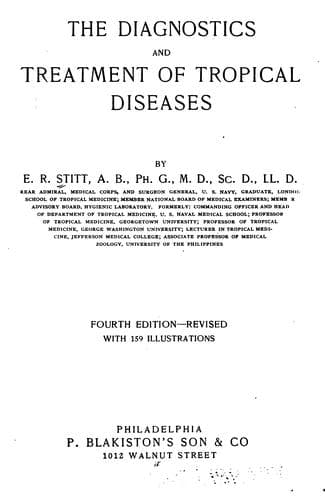
The diagnostics and treatment of tropical diseasesStitt, E. R. (Edward Rhodes)
Science
The diagnostics and treatment of tropical diseases
Stitt, E. R. (Edward Rhodes)
Tropical medicine
=Epidemiology.=—There is a consensus of opinion that every case of
leprosy owes its origin to contact, direct or indirect, with some
other case, but evidence as to the manner in which the disease is
transmitted, or even the proof of transmission, is to a great extent
lacking.
Every book refers to the inoculation experiment by Arning, of a
freshly excised leprous nodule sewn into a skin incision of the arm
of a condemned criminal. In this case a neuritis developed shortly
after the inoculation and the patient showed fully developed
leprosy three years later. Unfortunately for the value of the
experiment the man was a native of Hawaii and had lepers in his
own family. Against this experiment are the numerous instances
where physicians have inoculated themselves and others with leprous
material with invariably negative results.
Danielson inoculated himself and nine others with leprous material
and later Profeta repeated the same, but without success in a single
instance.
As regards those living for a long time in attendance on lepers
there have been a very few instances of the contraction of leprosy
as in the case of Father Damien at Molokai, and two instances in
Sisters of Mercy. Such cases however are most exceptional, as the
hundreds of attendants on the unfortunates continue their work for
years without showing any signs of leprosy.
It is stated that there has never been an instance of transmission of
leprosy to any attendant at the Saint Louis Hospital, Paris.
There are two cases which show that those who live in close
relation to lepers may develop the disease; in one, a leper
returned to Ireland and his brother, who had never been in a
leprosy country, but who had occupied the same bed with the leper
and worn his clothes, developed the disease in about five years. A
similar case is reported from Germany.
As showing that even with intimate contact, infection is rare, it is
stated that of 225 healthy Hawaiians, living in the same houses with
lepers, only 4½% contracted leprosy. Even when married to lepers only
9 out of 181 healthy people contracted leprosy from their leprous
mates.
In Japan, 7% of children of lepers contract the disease, 3.8% of
those married to lepers and 2.7% of people living in the same house
with lepers.
Just as with tuberculosis, in which all evidence points to the
predominance of infection in early life and its infrequency in
adult life, so does it seem to be true of leprosy. Among 10,000
lepers in the Culion leper colony, Denny notes that 35% were
brothers and sisters, 27% were cousins, 11% were children of
lepers, 7% parents of lepers, and only 1% husband and wife. This
would indicate that the relationships involving intimate contact in
childhood are etiologically most important.
Public-domain text, read in full here on John Shaqi.
Reviews
Reviews
No reviews yet
Be the first to share your thoughts on this work.
Elsewhere in the archive
Join the Discussion
Join the discussion
Sign in to leave a comment or review.
Sign InorCreate an account