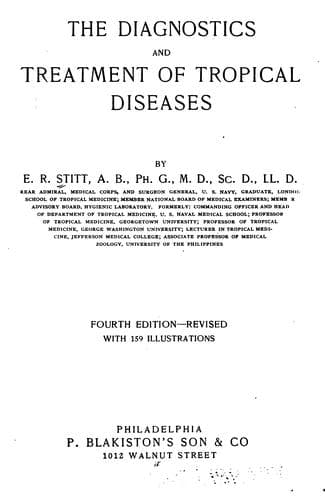
The diagnostics and treatment of tropical diseasesStitt, E. R. (Edward Rhodes)
Science
The diagnostics and treatment of tropical diseases
Stitt, E. R. (Edward Rhodes)
Tropical medicine
The period of incubation of leprosy is peculiarly prolonged and is
at any rate from two to five years and may extend over many years,
Hallopeau having recorded a case where the disease did not develop
for twenty-seven years after the patient left the infected district.
The early manifestations are vague and indefinite, consisting chiefly
of malaise, weariness and mental depression.
There are often noted (_a_) irregular accessions of fever (leprotic
fever), attended with rather profuse sweating, so that the onset
may be mistaken for a malarial infection; (_b_) progressive
weakness, the patient being easily fatigued with a tendency to
somnolence; (_c_) alternating attacks of dryness and hypersecretion
of the nasal mucous membrane, with frequent attacks of epistaxis,
and (_d_) various neuralgic manifestations or paraesthesias as well
as headache. These prodromal manifestations usually precede but may
accompany the outbreak of the spots.
It is the prominence of the nasal manifestations that has caused
Sticker to insist that the primary lesion of leprosy is of the
nasal mucosa, the general view, however, being that this view
is without sufficient foundation and as a matter of fact some
have recently suggested that the disease first manifests itself
in the lymphatic glands, punctures of such structures showing
bacilli rather frequently, although in less proportion than upon
examination of the nasal mucosa.
All authorities recognize two well-separated clinical types of
leprosy, one the nodular, skin, hypertrophic or tubercular form and
the other the smooth, nerve, maculo-anaesthetic or atrophic form.
These fairly distinct types tend to run into one another and in
such cases we have the mixed form of the disease.
Following Manson I use the terms nodular and nerve leprosy. It is
usually stated that in Northern climates nodular leprosy forms about
70% of cases while, in the tropics, the larger proportion is made up
of nerve leprosy.
At one time a classification of the 239 lepers at San Lazaro
Hospital, Manila, P. I., showed 97 cases of nodular, 42 of nerve
and 93 of mixed leprosy, with two cases of doubtful nature.
NODULAR LEPROSY
_A Typical Case._—After more or less indefinite and uncharacteristic
prodromata the definite onset is by an outbreak of brownish red spots
which later become pigmented and thickened. These spots are at first
erythematous and tend to come out in crops, attended with attacks of
irregular fever. They soon have the appearance of limited areas of
sunburn. They vary in size from 1 or 2 millimeters to a blotch the
size of the palm of the hand.
They are raised and have a preference for appearing on the lobes of
the ears, the nasal alae, the forehead, eyebrows, cheeks and chin.
Public-domain text, read in full here on John Shaqi.
Reviews
Reviews
No reviews yet
Be the first to share your thoughts on this work.
Elsewhere in the archive
Join the Discussion
Join the discussion
Sign in to leave a comment or review.
Sign InorCreate an account