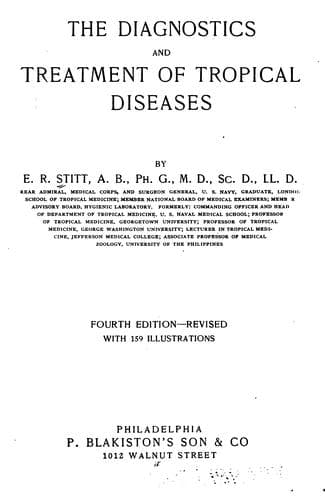
The diagnostics and treatment of tropical diseasesStitt, E. R. (Edward Rhodes)
Science
The diagnostics and treatment of tropical diseases
Stitt, E. R. (Edward Rhodes)
Tropical medicine
It is possible that sodium morrhuate (cod-liver oil) may be as
efficacious as the gynocardate salt. Rogers has used _Hydnocarpus_
instead of the true chaulmoogra oil and thought he obtained better
results. One explanation of the uncertainty of success with
chaulmoogra oil is the difficulty of securing oil obtained from
proper sources. The standard treatment of leprosy in Honolulu, as
reported by McDonald, is the weekly injection of the ethyl esters
of the entire fatty acids of the whole chaulmoogra oil, with 2% by
weight of iodine, chemically combined. The treatment begins with 1
cc. injected intramuscularly, increased by 1 cc. at every second
or third injection, until a dose of from 2 to 6 cc. is reached,
according to age and weight of patient.
For internal use the mixed fatty acids, carrying 2½% iodine,
chemically combined, are given in capsule. The dose by mouth is
0.25 grams per 100 lbs. weight, three times daily, an hour or two
after meals. This is gradually increased every two weeks until a
maximum dose of 1 gm. per 100 lbs. weight is reached.
Dyer combines hydrotherapy with the administration of chaulmoogra
oil. He gives a daily bath as hot as can be borne, and, in addition
to the specific treatment, gives 1/60th grain of strychnine three
times daily.
Antileprol, a preparation of chaulmoogra oil, which is more
satisfactory than oil, may be given in doses approximating 120 grains
by mouth daily or 60 grains subcutaneously. Such drugs as arsenic
salicylate of soda and bichloride of mercury have been used.
Thyroid extract has seemed to benefit cases of anaesthetic leprosy
in rare instances. The high frequency current with the needle
applied to the nodular lesions has been recommended by Unna. Radium
and X-rays have also been employed. There have been reports as to
the value of the antimony treatment in leprosy.
Leprosy is a disease in which improvement often occurs when the
patient is placed under more favorable conditions as to food,
climate, etc. Again, there is at times a tendency for the disease to
abort or ameliorate without relation to treatment or environment.
Surgical treatment is frequently of use, as nerve stretching for
the leprous neuralgias. Various eye operations are necessitated
by the ectropion or leprotic iritis. The amputations of the area
involved in perforating ulcer is recommended. Tracheotomy is often
demanded for the laryngeal stenosis.
McCoy has combined carbon dioxide snow local treatment with
chaulmoogra oil. The lesions showed decrease in size but remained
bacteriologically positive.
SECTION III
FOOD DEFICIENCY DISEASES
CHAPTER XVIII
BERIBERI
DEFINITION AND SYNONYMS
Public-domain text, read in full here on John Shaqi.
Reviews
Reviews
No reviews yet
Be the first to share your thoughts on this work.
Elsewhere in the archive
Join the Discussion
Join the discussion
Sign in to leave a comment or review.
Sign InorCreate an account