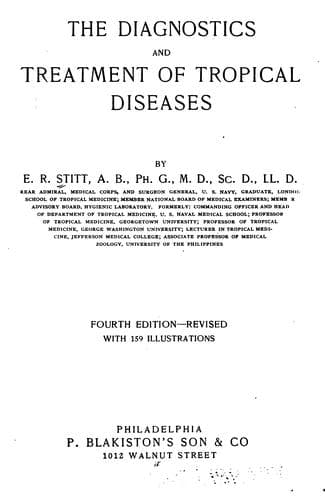
The diagnostics and treatment of tropical diseasesStitt, E. R. (Edward Rhodes)
Science
The diagnostics and treatment of tropical diseases
Stitt, E. R. (Edward Rhodes)
Tropical medicine
Various bacilli, other than that incriminated by Wright, have been
brought forward as pathogenic agents but it may be stated without
further discussion that the claims of the advocates of bacterial
causes have not been verified and are solely of historical
interest. The same statement will hold for the plasmodium-like
protozoon of Glogner which was found in the splenic blood.
_Of the chemical theories_ may be mentioned; (1) Arsenic poisoning.
In an outbreak of arsenical neuritis in England, from arsenic
contained in the glucose used in making beer, Ross diagnosed the
illness as beriberi. Subsequently, arsenic was found in the hair of
certain patients with beriberi, hence the theory which has never
been substantiated. It may be stated that a careful study of this
epidemic by Reynolds and Bury indicated that the alcoholic factor
was also operative as persons taking an equal amount of arsenic but
without alcohol, did not develop neuritis.
(2) Treutlein’s oxalate theory.—This was based on the fact that
polyneuritis gallinarum could be produced in fowls by feeding them
oxalic acid.
_Of the food deficiency theories_, the most prominent is (1) that
of Takaki, generally designated the _nitrogen deficiency_ theory.
As the result of increasing the proteid constituents of the ration
of the Japanese Navy from 109 to 196 grams, the disease was largely
eliminated (from about 32% incidence to less than 0.5%).
In the old ration the ratio of N to C was as 1 to 17—32, in the
new ration, 1—16. In looking over the constituents of the new
ration the addition of about 100 grams of beans is noted. These are
rich in vitamines.
(2) According to Fales the hypothetical germ of beriberi can only
live in body fluids deficient in potassium carbonate. The high
content of potash in potatoes made him greatly increase the amount
of this vegetable in the dietary he recommended. Fales noted scurvy
as well as beriberi in the Bilibid prisoners on a diet deficient in
potash.
(3) Deficient fat. (4) Deficient phosphorus.—It was Schaumann’s
idea that the phosphorus contained in the outer layers of the rice
grain was essential in the prevention of beriberi. While it is
now known that the beriberi-preventing substance does not contain
phosphorus, yet the idea has proven of practical value as giving an
index of beriberi-producing power of rice.
_P_{2}O_{5} Index of Beriberi-producing Rice._—If a rice contain
under 0.4% of phosphorus pentoxide it is liable to produce beriberi.
Schaumann now considers that the antineuritic substance in rice
polishings acts as an activator in the metabolism of phosphorus.
Public-domain text, read in full here on John Shaqi.
Reviews
Reviews
No reviews yet
Be the first to share your thoughts on this work.
Elsewhere in the archive
Join the Discussion
Join the discussion
Sign in to leave a comment or review.
Sign InorCreate an account