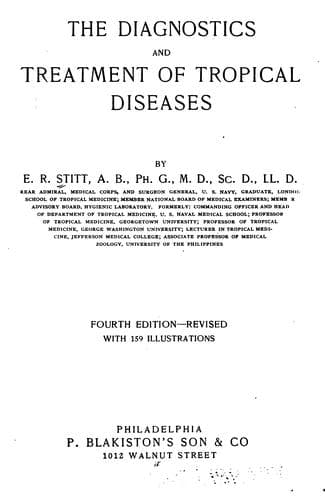
The diagnostics and treatment of tropical diseasesStitt, E. R. (Edward Rhodes)
Science
The diagnostics and treatment of tropical diseases
Stitt, E. R. (Edward Rhodes)
Tropical medicine
Probably the most important conditions to consider in differentiation
of beriberi are the peripheral nerve involvements caused by alcohol
and arsenic.
In alcoholic neuritis there is the history of alcoholic excesses,
long-standing digestive disorders and tremors of hands, lips and
tongue. Chiefly characteristic, however, is the mental involvement,
such cases almost always showing loss of memory and defective
mental concentration.
Mental symptoms and tremors are practically absent in beriberi and
we have here the marked feature of vagal involvement plus vasomotor
phenomena.
In arsenical neuritis we have an early puffiness under the eyelids
and pigmentation of the skin which first shows itself in areas
normally pigmented. A dysenteric syndrome may also be present.
There would be less chance of confusing lead palsy as this chiefly
involves the upper extremity. Punctate basophilia, lead colic and
the blue line on the gums should differentiate.
In diphtheritic palsies the muscles of the soft palate are involved
in more than 75% of cases. Ocular palsies are also not infrequent.
In lathyrism we have a history of the eating of the chick-pea
(Lathyrus sativus) or other vetches, as may occur in times of famine.
Pain in the back, weakness of the legs and symptoms of spastic
paraplegia appear. The spasticity differentiates. The heart is not
affected.
It may be stated that there is no laboratory diagnosis for beriberi.
PROGNOSIS
There is no disease in which one should be more conservative in
making a favorable prognosis than in beriberi. A case which seems
to be progressing toward recovery may suddenly develop cardiac
disturbances and die in a very short time.
We now know that a change to a beriberi-preventing diet is
practically curative.
The mortality rate varies in different countries and in different
epidemics, so that we have death rates varying from less than 2 per
cent. to those exceeding 50 per cent. In acute pernicious beriberi
the prognosis is almost surely fatal.
The epidemic of beriberi which prevailed at Manila in 1882 seems to
have been attended by a great mortality, this having been as high
as 60% during the early part of the outbreak.
PROPHYLAXIS AND TREATMENT
=Prophylaxis.=—It must be remembered that not only is rice, from
which the neuritis-preventing vitamine has been removed by excessive
milling, productive of beriberi but that the same applies to other
cereals which have been similarly deprived of their vitamines.
The same result may be obtained by the employment of excessive
sterilization for canning.
Fresh meat is as valuable as fresh vegetables in prophylaxis but if
either kind of food be subjected to excessive heat, as is the case
with tinned meats, etc., they not only do not prevent beriberi but in
a negative way are beriberi-producing.
Public-domain text, read in full here on John Shaqi.
Reviews
Reviews
No reviews yet
Be the first to share your thoughts on this work.
Elsewhere in the archive
Join the Discussion
Join the discussion
Sign in to leave a comment or review.
Sign InorCreate an account