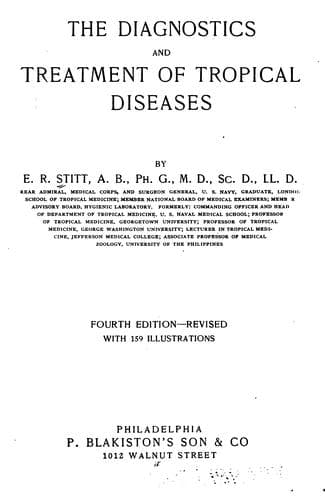
The diagnostics and treatment of tropical diseasesStitt, E. R. (Edward Rhodes)
Science
The diagnostics and treatment of tropical diseases
Stitt, E. R. (Edward Rhodes)
Tropical medicine
Strychnine is usually given as a routine treatment in the less
acute cases. With muscular atrophy massage is of prime importance.
Electrical stimulation is also usually employed. With the palsies
there is great danger of contractures so that even the bed clothing
should not rest upon the paralyzed feet. Even splints may be
necessitated.
CHAPTER XIX
PELLAGRA
DEFINITION AND SYNONYMS
=Definition.=—For a time it seemed as if the old idea that pellagra
was connected with a dietary defect, chiefly as regarded some factor
in a preponderating diet of maize, had been replaced by one assigning
as cause some infectious process, probably protozoal, possibly
bacterial.
The important advances recently made in the study of beriberi have
tended once more to swing the pendulum to the food deficiency
etiology. The latest views assign to food deficiency the basic
etiology, but regard some other factor, possibly an infectious one,
as secondarily operative.
The disease is essentially chronic with periodic exacerbations but
may run a rather acute course with a rapidly fatal termination. The
trend of symptoms consists of (1) mild neurasthenic manifestations
in the winter to be followed in the spring by (2) disturbances of
the alimentary tract, consisting of stomatitis, burning sensations
going up the oesophagus, gastric eructations and recurring
diarrhoeas. (3) In addition to the neurological and alimentary
tract symptoms we have the third and diagnostically the most
important group, those of the cutaneous system. The pellagrous
eruption is characterized by strikingly symmetrical, sharply
delimited patches of erythema, resembling sunburn. The sites of
preference are backs of hands, extending up the forearms, bridge of
nose or neck. The neurasthenia tends to pass into a toxic psychosis
or even a confusional insanity.
=Synonyms.=—Maidismus, Alpine Scurvy, Asturian Leprosy, Mal de la
Rosa, Mal del Sole.
HISTORY AND GEOGRAPHICAL DISTRIBUTION
=History.=—Strambio considers some of the references of
Hippocrates to refer to pellagra but Castellani and Chalmers state
that after searching the writings of Hippocrates they have been
unable to find any references to a disease showing a resemblance to
pellagra.
The first definite description of the disease is generally credited
to Casal who, in 1735, described the disease as it existed in the
Asturias.
In his writings he notes that the peasants lived chiefly on corn
and that they rarely had fresh meat.
Casal’s paper was not published until 1762 but Thitery, who visited
Spain and was shown cases of pellagra by Casal, described the
disease in 1755 and gave full credit to Casal for the recognition
of the disease. The name of the disease was given it by Frapolli,
in 1771, the derivation being from pelle—skin, and agra—rough.
The disease had then existed in Italy for a considerable time.
Casal called the disease mal de la rosa.
Public-domain text, read in full here on John Shaqi.
Reviews
Reviews
No reviews yet
Be the first to share your thoughts on this work.
Elsewhere in the archive
Join the Discussion
Join the discussion
Sign in to leave a comment or review.
Sign InorCreate an account