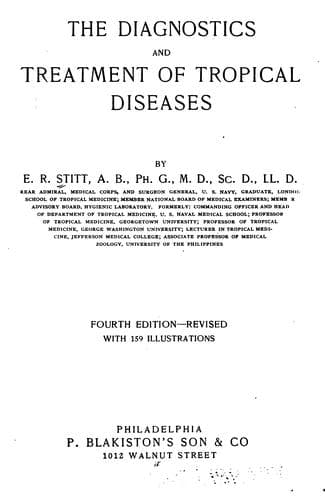
The diagnostics and treatment of tropical diseasesStitt, E. R. (Edward Rhodes)
Science
The diagnostics and treatment of tropical diseases
Stitt, E. R. (Edward Rhodes)
Tropical medicine
Leaves of plants contain it in abundance, while with seeds it is
present in less degree and then contained in the embryo, which
latter is lost in milling. Millet contains an exceptionally large
amount of fat soluble A and it is well known that in Egypt those
living on millet instead of maize escape pellagra. The protein of
millet has a high biological value which is the reverse with that
of maize. It should be noted that besides vitamine and protein
deficiencies the lack of inorganic salts should be considered.
_Protein Deficiency._—Animal protein is a superior protein and
maize protein an inferior one. Wilson grades proteins according to
their assimilability and taking meat protein as 1 he assigns to
maize protein a relative value of 3.4, which means that one must
consume 3.4 times as much maize protein as that of meat to obtain
the necessary protein requirements. Thirty grams of animal protein
daily is sufficient to maintain nitrogenous equilibrium but Wilson
considers 40 as a minimum B. P. V. (Biological protein value). We
should have to consume 136 grams of maize protein to obtain a B. P.
value of 40. Where hard labour is required the B. P. V. should be
50 and when associated with chronic intestinal disease it should be
as high as 60.
Wilson noted a B. P. V. of 23 for males in the diet which caused an
outbreak of pellagra in Armenian refugees at Port Said. The diet of
the pellagrous Turkish prisoners in Egypt had a B. P. V. of 33.5.
It may be stated that zein, the protein of maize, is deficient in
tryptophane and lysine, two important amino-acids necessary for
proper nutrition. Chick apparently produced pellagra in a monkey
fed on a low protein diet (Total protein 8.2 grams, of which all
but 2.7 grams was from zein.). The monkey was given an abundance of
accessory food substances in butter, marmite and orange juice.
_Amino-acid Deficiency._—In a recent paper Goldberger and Tanner
note that a low biological protein value is not necessarily
indicative of a pellagra-producing diet. In a series of experiments
the deficiency of vitamines did not seem to be related to pellagra
production and the same was true of the mineral elements. In
studying the nature of low protein biological values they were of
the opinion that this rested in certain amino-acid deficiencies in
the proteins consumed by the pellagrins. Benefit seemed to result
from administering cystine to two cases of pellagra and in a third
case there was steady improvement following the giving of both
cystine and tryptophane.
It is a question whether zein, the principal protein of maize,
contains any cystine.
Public-domain text, read in full here on John Shaqi.
Reviews
Reviews
No reviews yet
Be the first to share your thoughts on this work.
Elsewhere in the archive
Join the Discussion
Join the discussion
Sign in to leave a comment or review.
Sign InorCreate an account