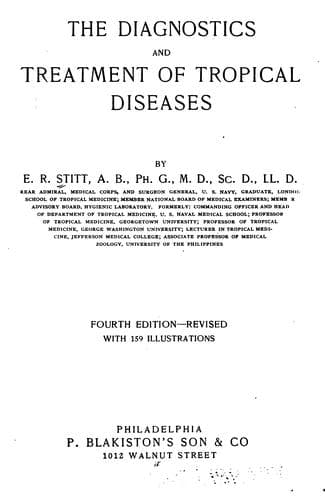
The diagnostics and treatment of tropical diseasesStitt, E. R. (Edward Rhodes)
Science
The diagnostics and treatment of tropical diseases
Stitt, E. R. (Edward Rhodes)
Tropical medicine
One of the characteristic features of pellagra is the periodic
recurrences in spring, with almost complete cessation of skin and
alimentary tract symptoms in the winter and, again, the tendency
in many cases for one group of symptoms to overshadow the symptoms
which usually accompany them. These periodic recurrences may well
be associated with seasonal variation in diet.
=Stages in Pellagra.=—For many reasons it is peculiarly difficult
to recognize stages but for convenience many authors describe the
disease under a prodromal, 1st, 2d and 3d stage.
These stages have reference solely to the degree of severity of the
manifestations and a case may never progress beyond the 1st stage,
although recurring for a number of years. Again a case may rapidly
progress to the 2d stage and even run through the 3d or cachectic
stage in a few months. We must not consider these stages as tending
to follow in sequence as we do in connection with the stages of
syphilis.
_The prodromal manifestations_ of neurasthenia, malaise, loss of
weight, loss of strength, vertigo and digestive disturbances would
be suited to many other diseases, especially tuberculosis, and they
are rarely recognized as belonging to pellagra until the appearance
of typical skin or other symptoms brings about their association with
pellagra. There is little definite information as to the period of
incubation although Sandwith places it at from nine to twelve months.
In Goldberger’s cases the eruption did not appear until after five
months on the experimental diet. In the study of cases of pellagra
occurring among Armenian refugees, and in Turkish prisoners of
war, oedema was not infrequently noted and its occurrence usually
preceded the eruption.
=First Stage.=—In the first stage we note the alimentary tract
disturbances of sodden fissured conditions at the angles of the
mouth, a large indented tongue with central coating and bare
glistening sides and tips, often with a shiny mucus coating these
red borders and a red buccal mucosa. The fungiform papillae appear
as pinhead red elevations. Later on the tongue becomes bare, red and
fissured. There is often an increased flow of saliva. Aphthous ulcers
are less common than in sprue. The gums are often quite tender and in
cases where they are somewhat spongy and swollen, with a tendency to
bleed, we note the appropriateness of “Alpine scurvy” as a synonym
for pellagra.
In cases with very severe stomatitis there may be enlargement
of the salivary glands. The pharynx is congested and a similar
condition of the oesophagus gives rise to a burning sensation which
is often described by the patient as going up the gullet from the
stomach.
Public-domain text, read in full here on John Shaqi.
Reviews
Reviews
No reviews yet
Be the first to share your thoughts on this work.
Elsewhere in the archive
Join the Discussion
Join the discussion
Sign in to leave a comment or review.
Sign InorCreate an account