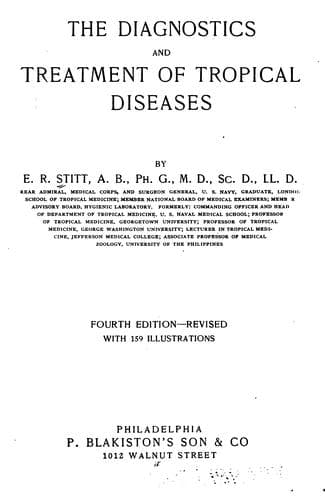
The diagnostics and treatment of tropical diseasesStitt, E. R. (Edward Rhodes)
Science
The diagnostics and treatment of tropical diseases
Stitt, E. R. (Edward Rhodes)
Tropical medicine
In a very important series of experiments on prisoners,
MacGilchrist found that hydroquinine (a synthetic product of
quinine) was about 20% more efficient than quinine. Cinchonine was
about the same as quinine while quinidine was about one-half as
potent as quinine.
Acton has praised the value of cinchona febrifuge (the combined
alkaloids of cinchona) given in daily doses of 21 grains for ten
days.
Methods of Administration
_By Mouth._—This is the usual method and is the one to be preferred
in all cases where other methods of administration are not
necessitated.
Golgi believes that quinine is most effective at the time of
liberation of merozoites from the bursting merocytes, hence he
administered quinine four hours before the attack with a view to
having it in its greatest concentration in the blood at such times.
When given intravenously the full concentration is obtained in a
very few minutes but with other methods this is a matter of great
variation.
It is usual to give the quinine in capsules or cachets, the pills
and tablets being often so hard that they do not dissolve in the
alimentary tract.
The method usually in vogue in military services is to give quinine
sulphate in acid solution. This method is trying to the stomach.
_By Subcutaneous Injections._—This method is liable to be followed
by necrosis and abscess formation or fibrous indurations. Quinine
and urea hydrochloride is preferable either for subcutaneous or
intramuscular injection.
Cohen holds that quinine and urea hydrochloride controls malarial
infection more rapidly and efficaciously than any other salt of
quinine when given intramuscularly. In order to prevent tetanus or
other infections he is very careful about asepsis. He recommends
that a 10 to 15-grain dose be injected every day for a week, then
once a week for a month, then once every two weeks for another
month. He considers a 33% solution as best, thus one could give 10
grains in the contents of an all-glass 2 cc. syringe.
James has recommended very dilute solutions for subcutaneous
injections (1-150). There are practical objections to this method.
It is usual to give about 1 gram (15 grains) of a soluble salt in
10 cc. of water. _The present view is that subcutaneous injections
deserve condemnation._
_Intramuscular Injections._—It is now recognized that when quinine
is not well borne when given by mouth the two modes of administration
to be followed are either by intramuscular injection or introduction
of the drug into a vein. For intramuscular use we dissolve a soluble
salt of quinine, as the bimuriate or chlorhydrosulphate, in distilled
water or sterile saline. A 50% solution is commonly used and from 6
to 10 grains of quinine is injected into the gluteal muscles of one
side about 3 inches below the iliac crest. Repeat the injection on
the other side. Repeat this daily dose of 12 to 20 grains for 3 or 4
days; then give quinine by mouth.
Public-domain text, read in full here on John Shaqi.
Reviews
Reviews
No reviews yet
Be the first to share your thoughts on this work.
Elsewhere in the archive
Join the Discussion
Join the discussion
Sign in to leave a comment or review.
Sign InorCreate an account