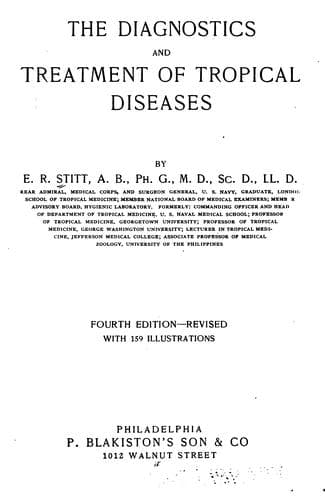
The diagnostics and treatment of tropical diseasesStitt, E. R. (Edward Rhodes)
Science
The diagnostics and treatment of tropical diseases
Stitt, E. R. (Edward Rhodes)
Tropical medicine
The solution should be autoclaved before use and the skin at the
site of injection painted with iodine. Dudgeon has called attention
to the constant production of oedema and necrosis in the area of
the injection. This tissue necrosis occurs immediately and persists
for a long time. If the injection is made in the neighborhood of an
important nerve, neuritis may ensue. Repeated injections should not
be given in the same area.
Of course in the use of quinine salts through the medium of the
hypodermic needle everything must be sterile.
_Intravenous Injections._—Bass and many others think that when
quinine cannot be administered by mouth it should be given
intravenously. Not only is there the objection of inflammatory
reactions or necrosis when the drug is given subcutaneously or
intramuscularly but the absorption of the drug is so slow that the
patient may die before we obtain the desired effect. Ross condemns
the subcutaneous method and recognizes the advantages of the
intravenous method over the intramuscular one when rapidity of action
is desirable.
In giving quinine intravenously Bass thinks that 10 grains at one
time is sufficient and that a 20-grain dose is not without danger.
He does not think it necessary to give more than 30 grains daily
in this way. Intravenous quinine seems to be entirely eliminated
within twenty-four hours and most of it within twelve hours.
When used in cerebral malaria he repeats the 10 grains
intravenously in eight hours if the drug cannot then be given by
mouth. Bass thinks that theoretically amyl nitrite might relax the
cerebral capillaries which are obstructed by parasite-infected red
cells and thus enable the quinine in the circulation to reach such
cells.
The best known method of administering quinine intravenously is
that of Bacelli. In this method 1 gram (15 grains) of a soluble
salt of quinine is given in 10 cc. of water.
MacGilchrist has shown experimentally that such a strength of
quinine (1-10) will coagulate blood serum.
In my opinion this is a dangerous method if the injection is made
rapidly. There is no doubt as to the necessity for using the
intravenous channel in cerebral or algid types of perniciousness
when intramuscular injections do not give results. The generally
accepted method is to use a salvarsan technique with a dilute
solution of quinine, giving 1 gram (15 grains) of some soluble
salt of quinine in 250 cc. salt solution. Such injections should
be given cautiously. Quinine hydrochloride, which is soluble in
40 parts of water, is the salt usually recommended. MacGilchrist
considers the very soluble acid salts as haemolytic and prefers
to give quinine base—3 pints of a solution of the alkaloid,
containing about 12 grains.
Public-domain text, read in full here on John Shaqi.
Reviews
Reviews
No reviews yet
Be the first to share your thoughts on this work.
Elsewhere in the archive
Join the Discussion
Join the discussion
Sign in to leave a comment or review.
Sign InorCreate an account