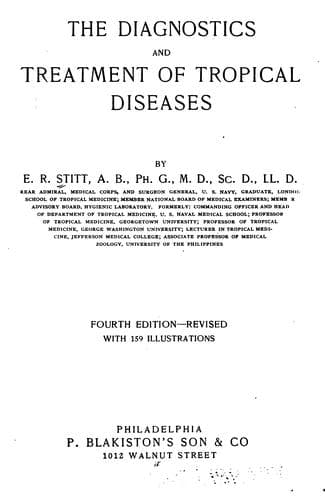
The diagnostics and treatment of tropical diseasesStitt, E. R. (Edward Rhodes)
Science
The diagnostics and treatment of tropical diseases
Stitt, E. R. (Edward Rhodes)
Tropical medicine
McLean has used concentrated solutions of quinine intravenously
several hundred times in cases of malaria (6 being blackwater fever
ones) without any untoward results. He autoclaves his 10-grain
solution of hydrochlor-sulphate in 10 cc. of sterile water for
twenty minutes at 15 pounds, and injects it slowly into an arm vein,
allowing about two minutes for the injection. The patients complain
of a slight cough and hot feeling in the lungs with a succeeding
dizziness which rapidly disappears. He is opposed to intramuscular
injections and found intravenous ones diluted 1 to 250 often to cause
shock and collapse.
_Rectal Administration._—Some authorities recommend the
administration per rectum of a soluble salt of quinine in about 3
times the usual dose by mouth or hypodermically. It is considered
applicable in cases where there is marked vomiting. It certainly is
the least satisfactory way of giving quinine.
_Dosage and Length of Treatment._—In Panama the standard preliminary
treatment is to give from 3 to 5 grains of calomel followed by 1 or 2
ounces of 50% magnesium sulphate.
Fayrer holds that a torpid liver interferes with the efficient
action of quinine, hence the value of calomel and salts. I prefer
to give 2 or 3 grains of calomel, in divided doses, followed by
sodium phosphate, 2 drams, every two hours, for three or four doses.
_Standard Method._—The National Malaria Committee of the United
States recommends the following treatment: Give 30 grains of quinine
daily in three 10-grain doses. Keep this up for 4 days and follow
by 10 grains every night for 8 weeks. Where the infection does not
present acute symptoms give the 10 grains daily for 8 weeks.
_Canal Zone Treatment._—So soon as the diagnosis is made give 15
grains of quinine 3 times daily (45 grains in twenty-four hours) and
continue such treatment for a week or until the temperature has been
normal for five or six days. Then give 10 grains 3 times daily for
ten or twelve days.
It is considered that by employing such thorough treatment from the
beginning the tendency to latency or relapse is prevented—in other
words the disease is really cured. It is interesting to note that
Torti recommended large single doses at the commencement of treatment.
Espach has noted that he had frequent relapses in many cases
treated by this method. In my opinion the Canal Zone treatment
should be followed by 10 grain doses daily for 8 weeks.
Tonics of iron, arsenic and strychnine are valuable in treating the
anaemia, but it is not advisable to add small doses of quinine to
such tonic mixture.
_Repeated Small Doses._—In Nocht’s method we give the quinine in
small doses repeated several times in the day, as 3 or 4 grains
given 5 or 6 times daily. Such treatment is thought advisable when
there is a tendency to haemoglobinuria or when giving quinine to
pregnant women.
Public-domain text, read in full here on John Shaqi.
Reviews
Reviews
No reviews yet
Be the first to share your thoughts on this work.
Elsewhere in the archive
Join the Discussion
Join the discussion
Sign in to leave a comment or review.
Sign InorCreate an account