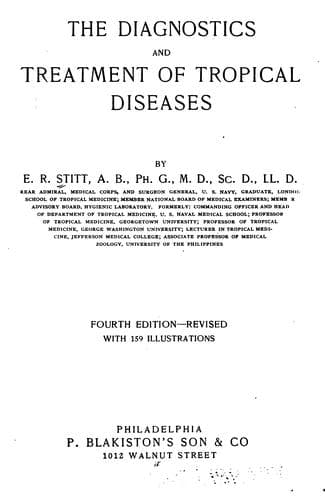
The diagnostics and treatment of tropical diseasesStitt, E. R. (Edward Rhodes)
Science
The diagnostics and treatment of tropical diseases
Stitt, E. R. (Edward Rhodes)
Tropical medicine
For the nausea sips of an ice-cold alkaline mineral water or
cracked ice will generally prove effective. In more refractory
cases spirits of chloroform or even a hypodermic of morphine
may be necessary. Counterirritation to the epigastrium is often
a help. Phenacetine may be given for the headache although ice
water compresses are generally sufficient. In algid states hot
water bottles should be applied to the body. During convalescence
excesses in food or drink should be avoided as well as fatigue or
exposure to wet or cold.
CHAPTER II
BLACKWATER FEVER
DEFINITION AND SYNONYMS
=Definition.=—Blackwater fever is a disease of disputed etiology
but recently there has seemed to be rather general agreement that it
is connected with repeated attacks of malaria. It is prone to affect
the old European residents of parts of the tropics where malignant
tertian is rampant.
On the basis of lowered integrity of the red cells, by reason of
repeated attacks of malaria, we may have extensive lysis of the red
cells following the administration of a dose of quinine or as the
result of refrigeration, excessive exposure to the sun or great
fatigue.
Clinically we have a prostrating chill of asthenic type
associated with early jaundice and the passage of porter-colored
urine—haemoglobinuria.
=Synonyms.=—Haemoglobinuric Fever, Bilious Haemoglobinuric Fever,
Haemorrhagic Malarial Fever.
French: Fièvre Bilieuse Hemoglobinurique. German: Schwarzwasserfieber.
HISTORY AND GEOGRAPHICAL DISTRIBUTION
=History.=—There is no reasonable doubt that the explanation of
the fact that blackwater fever was first brought to the attention
of the medical world, by Lebeau and other French naval surgeons,
in Madagascar, in 1850-1853, was due to the confusion of this
disease with the bilious remittent type of pernicious malaria as
well as with yellow fever. Even after the clinical picture was well
recognized, disputes as to the nature of the coloring matter of
the characteristic urine were frequent, some considering that the
dark color, which we now know to be due to haemoglobinuria, was due
to haematuria or that the color was due to bile. Blackwater fever
must have been the condition referred to in medical literature
of the period, 1850 to 1870, under the names “Fièvre bilieuse
haematurique,” “haemorrhagic malarial fever” and “febris remittens
haemorrhagica.”
It was first described in the U. S. by Cummings of Louisiana
in 1859. Other American physicians during the next ten years,
described the disease from various other Southern states.
Veretas noted the presence of the disease in Greece, in 1858.
Public-domain text, read in full here on John Shaqi.
Reviews
Reviews
No reviews yet
Be the first to share your thoughts on this work.
Elsewhere in the archive
Join the Discussion
Join the discussion
Sign in to leave a comment or review.
Sign InorCreate an account