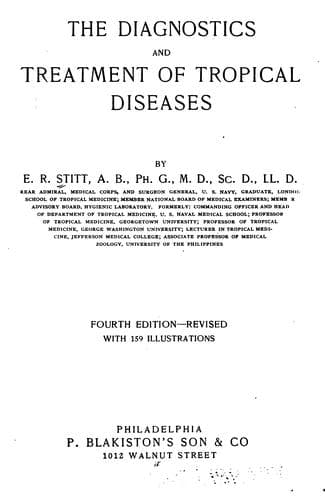
The diagnostics and treatment of tropical diseasesStitt, E. R. (Edward Rhodes)
Science
The diagnostics and treatment of tropical diseases
Stitt, E. R. (Edward Rhodes)
Tropical medicine
The idea as to etiology which now seems most generally accepted
is that blackwater fever occurs almost solely in those who have
resided for considerable periods of time in districts where malignant
tertian malaria is very prevalent and intense and who have repeatedly
suffered from such malarial attacks. Rarely blackwater fever may
be connected with benign tertian infections or exceptionally with
quartan ones. As a result of the damage done the patient by the
malarial attacks there is a tendency on the part of his red cells
to haemolysis which may be due to the production of a hypothetical
autolysin or to anaphylactic sensitizations, as has been suggested
recently.
Malaria is the predisposing cause and the exciting cause may be
any of a number of different factors capable of lowering body
resistance such as the occurrence of another malarial attack,
the administration of quinine, particularly of the acid salts of
quinine in rather large doses, refrigeration, as brought about by
one’s clothes becoming wet and then later subjected to the chilling
influence of a sea breeze, to excessive fatigue or dietetic or
alcoholic excesses.
Quinine administration, particularly if associated with
refrigeration, is the most common exciting factor.
As regards the association of malaria and blackwater fever
Stephens, in a study of 390 cases of blackwater, found that 73%
of the cases showed malarial parasites on the day preceding the
haemoglobinuria, 47.5% on the day of the attack and 23% on the day
following the appearance of the dark urine. Other workers give
higher figures as 95, 70 and 20%.
Where one utilizes the methods of examining for increased
percentage of large mononuclears or for melaniferous leucocytes,
in those cases not showing malarial parasites, the percentage
of evidence of malaria is greatly increased. It is necessary to
understand that a small percentage of cases diagnosed as blackwater
fever do not show evidences of malaria at autopsy and cases are
recorded where blackwater has attacked persons who had never had
malarial fever, such instances, however being exceptional.
_The Quinine Theory._—This idea as to the causation of blackwater
fever first originated with Veretas, in Greece, in 1858. Later
Tomaselli supported this view in Italy and more recently it was
advocated by Koch. Just as in connection with the influence of
Koch’s great prestige much harm was done in prophylaxis against
bovine tuberculosis so in this matter of quinine in the causing of
blackwater the influence was unfortunate because many persons with
severe malaria now refuse to take the specific quinine for fear of
bringing on haemoglobinuria.
Public-domain text, read in full here on John Shaqi.
Reviews
Reviews
No reviews yet
Be the first to share your thoughts on this work.
Elsewhere in the archive
Join the Discussion
Join the discussion
Sign in to leave a comment or review.
Sign InorCreate an account