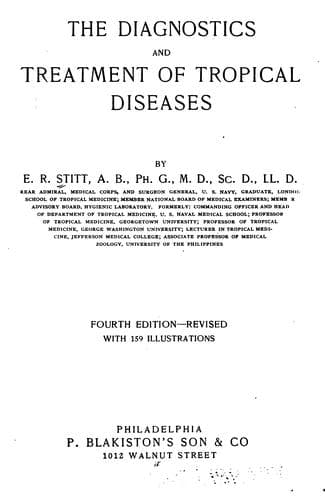
The diagnostics and treatment of tropical diseasesStitt, E. R. (Edward Rhodes)
Science
The diagnostics and treatment of tropical diseases
Stitt, E. R. (Edward Rhodes)
Tropical medicine
Rather profuse sweating accompanies the fall of the fever and the
patient is markedly debilitated after the subsidence of the fever.
There may be a recurrence of the paroxysm the following day. The
fever course, however, may be more or less continuous or remittent.
In other words it tends to be irregular and atypical.
Nausea and bilious vomiting come on early with epigastric distress.
Almost as pathognomonic as the haemoglobinuria is the early and
intense jaundice. This comes on within a few hours or almost
simultaneously with the haemoglobinuria and usually lasts for two or
three days after the haemoglobinuria and fever have ceased. Itching
of the skin of this jaundice is not noticeable.
The spleen and liver are enlarged and tender. Albuminuria comes
on with the haemoglobinuria and shows from 1/10 to 4/10 of 1% of
albumen by weight.
The pulse is rapid, 110 to 120, from the first but soon becomes
feeble and of low tension. In severe cases the very rapid almost
thready pulse, with pallor and cold extremities, may resemble a
severe haemorrhage. Epistaxis is not uncommon. A very unfavorable
symptom seems to be hiccough. Another frequent cause of death and
the one against which we chiefly direct our therapeutic measures
is anuria with subsequent uraemic symptoms, such as coma and
convulsions. At times a nephritis may develop in the course of a
blackwater attack and the case subsequently run as one of severe
nephritis.
Very striking is the rapidly developing anaemia, some cases showing a
loss of two million red cells in twenty-four hours.
The mind is usually clear throughout an attack, the patient showing
restlessness and marked anxiety.
In mild cases the fever course and haemoglobinuria is over within
twenty-four hours leaving the patient far more prostrated than
would a malarial paroxysm. In severe cases, however, the fever
runs a remittent course over several days, with more marked
haemoglobinuria and jaundice.
There may be cases which only show haemoglobinuria. These apyretic
cases have been considered by some as quinine haemoglobinuria.
Symptoms in Detail
_Fever Course._—This resembles that of a malarial paroxysm and may
be intermittent in character or last several days as a remittent
fever. The rigor which accompanies the febrile rise is intense.
_The Liver and Spleen._—As a result of the marked blood
destruction the liver is unable to dispose of the haemoglobin
outpouring and icterus, which usually comes on in a few hours and
is intense, is almost constant together with epigastric distress,
bilious vomiting and tenderness and slight enlargement of the
liver. The spleen is also somewhat enlarged and quite tender.
_The Circulatory System._—At first the pulse is rapid with tension
but soon it becomes weak, compressible and of low tension. In
severe cases it may have a rate of 150 or more or even become
thready.
Public-domain text, read in full here on John Shaqi.
Reviews
Reviews
No reviews yet
Be the first to share your thoughts on this work.
Elsewhere in the archive
Join the Discussion
Join the discussion
Sign in to leave a comment or review.
Sign InorCreate an account