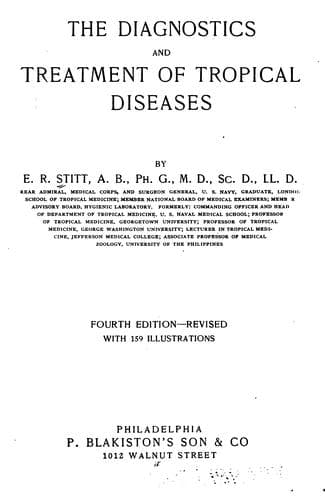
The diagnostics and treatment of tropical diseasesStitt, E. R. (Edward Rhodes)
Science
The diagnostics and treatment of tropical diseases
Stitt, E. R. (Edward Rhodes)
Tropical medicine
Of course if it be true that quinine base is devoid of haemolytic
influence the fear of increasing haemolysis by giving quinine would
not have to be considered. At any rate any red cells containing
parasites will surely be destroyed in the general haemolysis and
with them their contained parasites, so that it does not seem
reasonable to give quinine during the first day or two of the
attack. Quinine, if given, should not be by mouth for fear of
increasing the nausea and vomiting. The majority of authorities
hold that if parasites persist after two or three days from the
onset quinine is indicated. Some give quinine during the first day
if parasites are present but otherwise they withhold quinine.
Absolute rest in bed, avoidance of chilling and good nursing are the
prime considerations in treatment.
The patients should be given alkaline waters freely, as Vichy
or water containing 30 grains of bicarbonate of soda to the
pint. Cracked ice often tends to lessen the nausea and vomiting.
Albumin water or barley water may be retained better than milk or
broths. As the condition is so asthenic one cannot disregard the
nourishment of the patient during the first two or three days as is
true of the sthenic first stage of yellow fever. Hot fomentations
to the loins are indicated for relief of pain and the effect on the
renal congestion.
Saline enemata are of particular value and may suffice in mild
cases. In severe cases subcutaneous or intravenous saline
injections are necessary. Sorel recommends the intravenous
injection of lactose or glucose solutions in quantities of about
300 cc. (Crystallized glucose 47 grams, water 1000 cc. or C. P.
lactose 92.5 grams, water 1000 cc.) He also uses these sugar
solutions as enemata. Dry cupping or hot fomentations over the
loins are the usual remedies in threatened suppression of the
urine. If blackwater fever should be shown to be accompanied by
diminished alkalinity of the serum then the intravenous injection
of a 1 or 2% solution of bicarbonate of soda would be indicated.
Some have recommended calcium lactate in doses of 20 grains every
four hours. There is little evidence however to indicate that it
is of value. Transfusion of blood has been practised but reports
of such treatment indicate that while temporary improvement occurs
yet this is followed by a return of haemoglobinuria. From Dudgeon’s
work it would seem that the existing haemolysins would destroy the
foreign red cells.
Burkitt claims excellent results by intravenous injections of
alkaline solutions, similar to those recommended under “cholera.”
He also finds neosalvarsan of the greatest value in treatment, as
cases so treated convalesce most rapidly.
Hearsey advocates a mixture in which there is contained 10 grains
of bicarbonate of soda and 1/30 grain of bichloride of mercury in
each dose, to be given every two hours.
Public-domain text, read in full here on John Shaqi.
Reviews
Reviews
No reviews yet
Be the first to share your thoughts on this work.
Elsewhere in the archive
Join the Discussion
Join the discussion
Sign in to leave a comment or review.
Sign InorCreate an account