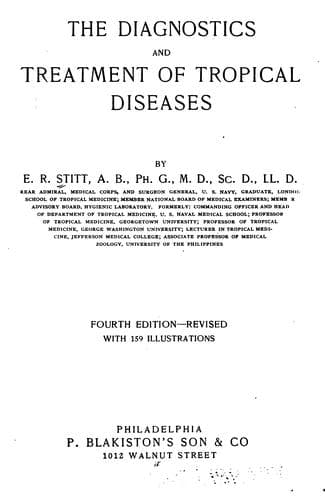
The diagnostics and treatment of tropical diseasesStitt, E. R. (Edward Rhodes)
Science
The diagnostics and treatment of tropical diseases
Stitt, E. R. (Edward Rhodes)
Tropical medicine
_The Lymphatic System._—Most important in diagnosis is the
enlargement of the lymphatic glands, especially those of the
posterior cervical triangle (Winterbottom’s sign). Other enlarged
glands may be the supraclavicular, epitrochlear and axillary
glands. The inguinal glands suffer enlargements so frequently
as the results of wounds and infections of the foot that their
enlargement is of less diagnostic value. The natives of certain
parts of Africa not only attach great diagnostic importance to
gland enlargement but they imagine they cure the disease by
removing the glands with various primitive cutting tools. The
glands are not painful, do not become matted together and rarely
suppurate. Our best means of diagnosing trypanosomiasis is by
withdrawing gland juice with a syringe and examining the smears.
_The Skin._—Erythematous areas may be present in Europeans.
Localized oedemas are rather marked features. The skin may be very
dry and itch markedly.
_Other Manifestations._—The spleen may be enlarged, the
respirations may be more rapid than normal and the blood show a
secondary anaemia. In a blood examination the large mononuclears
show an increase with a normal white count.
The eye may show keratitis or irido-cyclitis in trypanosomiasis.
Trypanosomiasis seems to favor abortion and still-births, in this
respect resembling syphilis.
DIAGNOSIS
In making a survey of a native population Schwetz considers gland
palpation as almost as reliable as gland puncture and of course more
expeditious. The typical gland should be large and soft or elastic
although he admits trypanosomes may be found in small hard glands.
When the glandular enlargement is distinct, with the erythema and
headache, there is much that suggests syphilis. Another point of
confusion is that positive Wassermann tests are often obtained in
sleeping sickness.
The increase in large mononuclears goes with malaria, kala-azar and
syphilis as well as with trypanosomiasis so that such findings are
of little assistance in differential diagnosis.
An early history of attacks of fever, with marked fluctuation of
temperature, associated with rapid pulse, even with the apyrexial
morning fall, is suggestive. Then with the glandular enlargements
we think immediately of laboratory examinations. As with pellagra
the history is very important in the diagnosis of trypanosomiasis.
_For the laboratory diagnosis_ we may use peripheral blood with
some thick film method. The examination of preparations from the
peripheral blood is usually very discouraging. Very much better
results (in fact some prefer this method to any other) can be
obtained by taking 10 to 20 cc. of blood in about 25 cc. of citrated
salt solution, centrifuging 2 or 3 times and examining the sediment
of the third centrifugalization. Dutton and Todd prefer to centrifuge
citrated blood and to collect the leucocyte layer for examination as
is done in opsonic work.
Public-domain text, read in full here on John Shaqi.
Reviews
Reviews
No reviews yet
Be the first to share your thoughts on this work.
Elsewhere in the archive
Join the Discussion
Join the discussion
Sign in to leave a comment or review.
Sign InorCreate an account